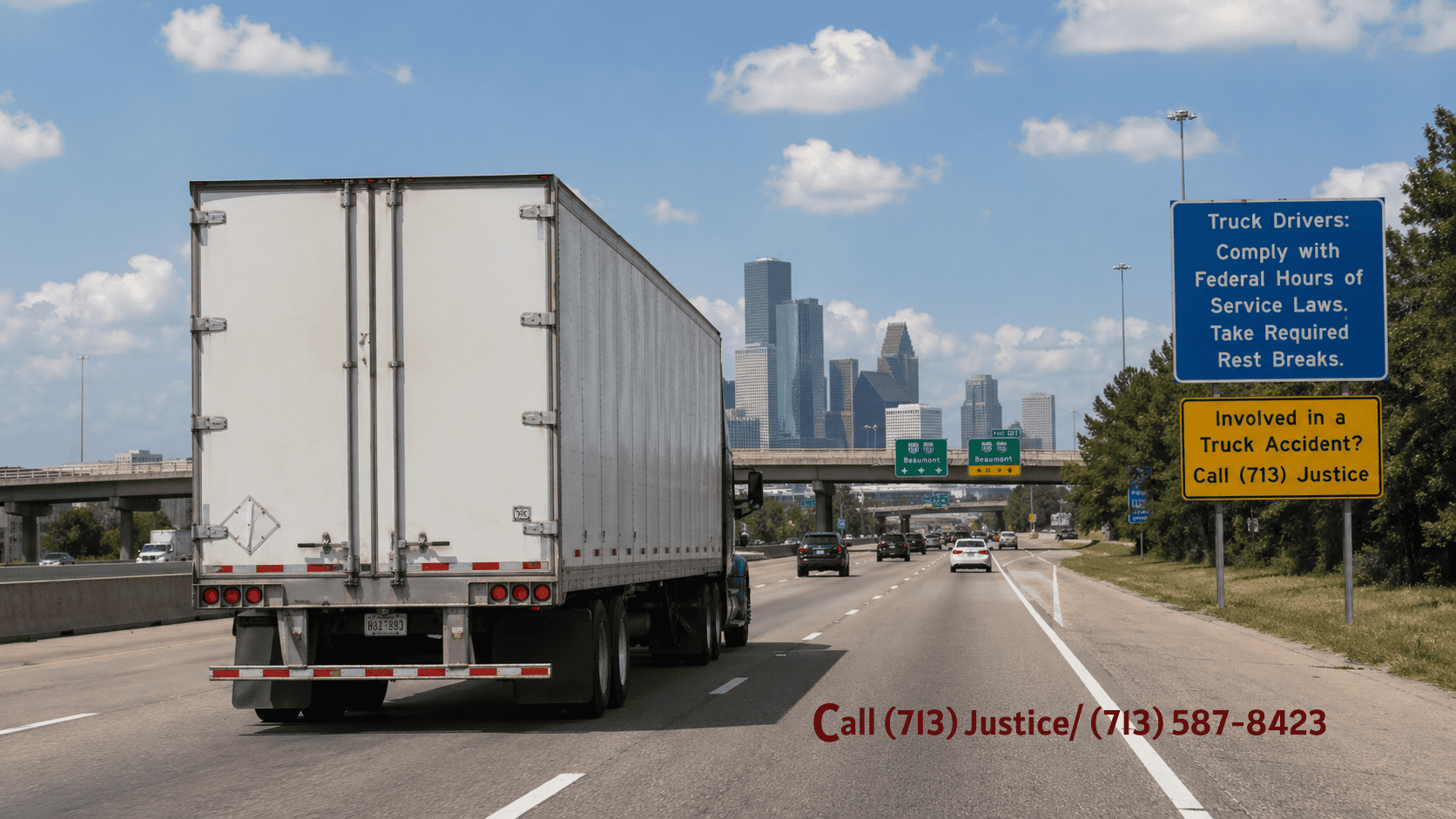
Federal 18-wheeler drive time limits allow 18-wheeler drivers to 11 hours of driving within a 14-hour on-duty window, followed by 10 consecutive hours off, and no more than 60–70 hours per week. Texas intrastate rules allow 12 hours of driving after 8 hours off. When trucking companies pressure drivers to push past these limits, fatigued drivers pose a deadly threat on Houston’s highways — especially on I-10, I-45, and Beltway 8. If you were hurt by an exhausted truck driver, Molina Law Firm fights to hold carriers accountable. Call (713) JUSTICE/ (713) 587-8423.
- Federal FMCSA rules cap property-carrying truck drivers at 11 hours of driving per day inside a 14-hour window.
- Texas intrastate rules allow up to 12 continuous driving hours — but only after a full 8-hour rest period.
- Drivers must take a 30-minute break before reaching 8 consecutive hours of driving under federal rules.
- Weekly limits cap drivers at 60 hours in 7 days or 70 hours in 8 days; a 34-hour reset restarts the clock.
- ELD (Electronic Logging Device) data is critical evidence in fatigued-driving cases — it must be preserved immediately after a crash.
- Harris County leads Texas in commercial vehicle crashes, with roughly 16% of all statewide CMV accidents occurring here.
- Hours-of-service violations can expose trucking companies to serious legal liability — and higher damages for victims.
Every day, thousands of massive 18-wheelers thunder down Houston’s freeways — I-10, I-45, Beltway 8, US-59, and the Ship Channel corridors — loaded with freight that keeps our city’s economy moving. Most of those drivers are professionals doing an incredibly demanding job. But when a trucking company pushes a driver to stay behind the wheel too long, or when a driver cheats the rules to make a deadline, a fatigued 80,000-pound big rig becomes one of the most dangerous vehicles on the road.
At Molina Law Firm, we represent Houstonians who have been seriously hurt in 18-wheeler crashes — and hours-of-service violations are one of the first things we investigate. Understanding these rules isn’t just for truck drivers. Every driver in Houston and Harris County deserves to know whether the truck next to them should even be on the road.
Why 18-Wheeler Drive Time Limits Matter So Much in Houston?
Houston is the fourth-largest city in the United States and home to the nation’s busiest petrochemical complex, one of the world’s largest port facilities, and a dense web of energy corridor traffic. That means our roads carry an enormous volume of commercial truck traffic — and the crash numbers reflect it.
Driver fatigue is consistently identified as a leading contributing factor in large truck crashes. According to FMCSA research, driver fatigue was the sole cause in approximately 13% of all commercial vehicle crashes — and that figure doesn’t include crashes where fatigue was one of several factors. Federal and Texas hours-of-service (HOS) rules exist specifically to prevent fatigued driving. When those rules are broken, real Houstonians pay the price.
Local Reality Check
Major freight corridors like I-10, I-45, and U.S. 290 see high concentrations of commercial vehicle crashes due to the sheer volume of freight moving to and from the Port of Houston. The Sam Houston Beltway (TX-8) alone has recorded thousands of commercial motor vehicle accidents in recent years.
What Are the Federal Hours-of-Service (HOS) Rules for 18-Wheelers?
The Federal Motor Carrier Safety Administration (FMCSA) — the federal agency tasked with reducing crashes involving large trucks and buses — sets mandatory hours-of-service (HOS) regulations for commercial motor vehicle (CMV) drivers operating in interstate commerce. These are the rules that apply when an 18-wheeler crosses state lines or carries federally regulated freight.
The 11-Hour Driving Limit
Under the FMCSA’s core property-carrying rule, a truck driver may drive a maximum of 11 hours in a single duty period — but only after having taken at least 10 consecutive hours off duty. Once the driver has used those 11 hours, they cannot drive again until they’ve rested for another 10 consecutive hours.
The 14-Hour On-Duty Window
This is one of the most critical — and commonly misunderstood — rules. Even if a driver hasn’t used all 11 hours of driving time, they cannot drive beyond the 14th hour after coming on duty. The 14-hour clock starts the moment the driver begins any work-related activity: pre-trip inspection, paperwork, loading, fueling, or driving. Non-driving tasks count toward the 14-hour window but not toward the 11-hour driving limit.
Example
A driver starts their shift at 5:00 AM. Even if they spent 3 hours on loading and paperwork, they must stop all driving by 7:00 PM — the 14th hour — regardless of how many hours they’ve actually spent behind the wheel.
The 30-Minute Rest Break Rule
Drivers cannot drive for more than 8 cumulative hours without taking at least a 30-minute break. This break doesn’t have to be a sleeper-berth rest period — it can be logged as off-duty, sleeper-berth time, or on-duty/not-driving time. The purpose is simple: sustained driving without a meaningful break dramatically increases the risk of fatigue-related impairment.
The 10-Hour Off-Duty Requirement
Before a driver can begin a new duty period, they must take at least 10 consecutive hours off duty. This mandatory rest period is designed to ensure drivers get enough sleep to be alert on the road. Drivers with a sleeper berth may split this rest using a 7/3 or 8/2 configuration under specific conditions.
What Are All of the Federal and Texas Drive Time Rules at a Glance?
| Rule | Federal (FMCSA) Limit | Texas Intrastate Limit | Applies To |
|---|---|---|---|
| Daily Driving Limit | 11 hours driving FMCSA | 12 hours continuous TX | Property-carrying CMV drivers |
| On-Duty Window | 14 hours max (breaks don’t pause it) FMCSA | Must stop at 14 hrs on-duty TX | All commercial drivers |
| Required Rest Before Shift | 10 consecutive hours off duty FMCSA | 8 hours off duty TX | Property-carrying CMV drivers |
| Mandatory Rest Break | 30-minute break after 8 hrs driving FMCSA | Not explicitly required intrastate TX | Interstate commerce |
| Weekly Limit (7-Day) | 60 hours on-duty in 7 days FMCSA | 70 hours in 7 days TX | Carriers not operating every day |
| Weekly Limit (8-Day) | 70 hours on-duty in 8 days FMCSA | 70 hours in 8 days TX | Carriers operating every day |
| Weekly Reset | 34 consecutive hours off duty FMCSA | 34 consecutive hours off duty TX | All commercial drivers |
Do Texas Truck Drivers Follow Different Rules Than Federal Drivers?
Yes — and this distinction matters greatly in Houston truck accident cases. Texas has its own hours-of-service rules that apply to intrastate commerce, meaning drivers whose routes stay entirely within the borders of Texas. When a truck crosses into Louisiana, New Mexico, Oklahoma, or another state, it falls under the stricter federal FMCSA rules.
Texas intrastate rules are generally considered more favorable to drivers, allowing a slightly longer 12-hour continuous driving period (versus 11 hours federally) after a shorter 8-hour rest period (versus 10 hours federally). Texas also allows drivers to split their mandatory 8-hour rest period into multiple segments inside a sleeper berth, as long as the shortest segment is at least 2 hours.
Importantly, hazardous materials drivers must comply with federal FMCSA HOS rules even when operating entirely within Texas — there is no intrastate exemption for hazmat loads.
Why This Matters for Houston Accident Cases
Determining which set of rules applies to the driver who hit you is a critical legal question. A driver hauling petrochemicals from Beaumont to Houston entirely within Texas follows Texas rules. That same driver hauling from Texas to a Louisiana refinery follows federal rules. An experienced Houston 18-wheeler accident attorney will investigate exactly which regulations applied — and whether the driver violated them.
How Does Driver Fatigue Cause 18-Wheeler Accidents in Houston?
Research consistently shows that driving while fatigued has effects similar to driving under the influence of alcohol. A truck driver who has been awake for 18 hours experiences cognitive impairment roughly equivalent to a blood alcohol level of 0.08% — the legal limit for intoxication in Texas. Behind the wheel of an 80,000-pound vehicle that needs the length of two football fields to stop at highway speed, that kind of impairment is catastrophic.
Specific Ways Fatigue Contributes to Crashes
- Slowed reaction time — A fatigued driver may not hit the brakes in time when traffic suddenly stops on congested sections of I-10 near the Energy Corridor or I-45 near downtown Houston.
- Lane drift — Microsleep episodes cause 18-wheelers to drift out of their lane, striking passenger vehicles traveling alongside them on Loop 610 or Beltway 8.
- Poor judgment — Fatigued drivers are more likely to misjudge gaps in traffic at interchanges, or fail to properly account for their extended stopping distance.
- Failure to recognize hazards — Reduced alertness means fatigued drivers may miss warning signs, construction zone signals, or stopped vehicles on Houston’s frequently congested freeways.
Which Houston Highways Are Most Dangerous for 18-Wheeler Fatigue Crashes?
Any road in Harris County can host a commercial truck accident, but certain corridors see disproportionately high volumes of freight traffic — and correspondingly higher crash rates:
How Do Electronic Logging Devices (ELDs) Prove Hours-of-Service Violations?
Prior to 2017, truck drivers recorded their hours on paper logbooks — which were notoriously easy to falsify. The FMCSA’s Electronic Logging Device (ELD) mandate changed everything. Today, most commercial truck drivers operating in interstate commerce are required to use an approved ELD that automatically and continuously records:
- Engine hours, vehicle movement, and miles driven
- Driver’s duty status changes (driving, on-duty/not driving, off-duty, sleeper berth)
- Location data at each duty status change
- Total driving hours and remaining available hours
This data is critical evidence in Houston truck accident cases. If a driver violated HOS rules before your crash, the ELD will show it. But there’s a catch: ELD data can be overwritten or lost quickly — sometimes within 30 days. This is why contacting a Houston 18-wheeler accident attorney as soon as possible after a crash is so important.
At Molina Law Firm, when we take a truck accident case, one of our first actions is to send a spoliation letter — a formal legal demand to the trucking company to preserve all data, including ELD records, GPS data, driver logs, dispatch communications, and black box (ECM) data. Trucking companies and their insurers have teams of lawyers and investigators on the scene immediately. You deserve experienced legal representation from the moment of impact.
What Happens When a Trucking Company Violates Hours-of-Service Rules?
Regulatory Consequences
The FMCSA and state enforcement partners can issue fines, place drivers out of service immediately during roadside inspections, and negatively impact a carrier’s Compliance, Safety, and Accountability (CSA) score. A poor CSA score affects insurance rates, business opportunities, and can trigger federal audits.
Civil Liability in Texas Personal Injury Cases
When a fatigued truck driver causes a crash in Texas, both the driver and the trucking company may be held liable. Texas law allows injured victims to pursue compensation for:
- Past and future medical expenses
- Lost wages and diminished earning capacity
- Physical pain and mental anguish
- Disfigurement and physical impairment
- Wrongful death damages for surviving family members
Importantly, when a trucking company knew its driver was violating HOS rules and did nothing — or worse, when the company pressured the driver to break the rules — Texas law may support a claim for additional exemplary (punitive) damages. These are damages designed to punish especially reckless corporate conduct.
Note: Texas recently passed legislation that limits how juries hear certain evidence about motor carriers’ safety violations in truck accident lawsuits. This makes having an experienced Houston truck accident attorney more important than ever.
What Should You Do If You Were Hit by a Fatigued 18-Wheeler Driver in Houston?
Call 911 immediately
Get law enforcement and emergency medical services on the scene. A police report is vital evidence. Ask the officer to note any signs of driver fatigue, and request the truck driver’s hours-of-service logs at the scene if possible.
Seek immediate medical attention
Even if you feel okay, get checked out. Many serious injuries — traumatic brain injuries, internal injuries, spinal injuries — have delayed symptoms. Medical records also document your condition and establish a timeline.
Document the scene if it is safe to do so
Photograph the truck (including license plate, DOT number, and company name), your vehicle, skid marks, road conditions, and any visible injuries. Get contact information from witnesses.
Do not speak to the trucking company’s insurance adjuster
Adjusters work for the carrier, not for you. Anything you say can be used to reduce your claim. Politely decline and refer them to your attorney.
Call Molina Law Firm at (713) JUSTICE immediately
The faster we act, the better we can preserve critical evidence. We will send a spoliation letter to the trucking company, obtain ELD data, black box records, dispatch logs, driver qualification files, and any prior safety violation history — before it disappears.
Hurt by a Fatigued Truck Driver in Houston?
Molina Law Firm fights for injured Houstonians — from the Ship Channel to Katy, Pasadena to The Woodlands. No fee unless we win your case.
CALL: (713) Justice/ (713) 587-8423 • Free Case Review • 24/7 Availability
Frequently Asked Questions: 18-Wheeler Drive Time Limits & Texas Truck Accident Law
You Don’t Pay Unless We Win
Houston 18-wheeler accident victims deserve a fighter in their corner. Molina Law Firm works on contingency — zero upfront fees, ever.
Call (713) JUSTICE — (713) 587-8423
Free Consultation • Hablamos Español • Serving All of Houston & Harris County

Rick Molina
Rick is a personal injury lawyer based in Houston, Texas who represents accident victims throughout Harris County and the Greater Houston area. Attorney Rick Molina began his legal career as an Assistant District Attorney (ADA) for Harris County, where he fought for victims' rights and prosecuted those responsible for serious crimes.
After leaving the District Attorney's office, Rick Molina worked at some of the largest law firms and insurance companies in Texas. Rick Molina earned his Bachelor of Arts from Rice University and his law degree from the University of Houston Law Center.
Related Links
- WRONGFUL DEATH:
- What Happens When An Unlicensed Driver Causes a Fatal Accident?
- Hit and Run Accidents
- Houston Wrongful Death Accident Claims
- Houston Wrongful Death Head-On Collisions
- Houston Wrongful Death Accident Attorney
- CAR ACCIDENTS:
- Experienced Houston Car Wreck Attorney
- Car Travel With Dogs
- Accidents, Emergency Rooms, and Urgent Care
- Houston Wrong Way Driving Accident Lawyer
- Texas Negligent Entrustment Claims
- Houston Auto Accident Attorney
- Accident Lawyers
- Rideshare Accidents
- Houston Chain Reaction Car Accident
- Houston Hit and Run Accident Lawyer
- Houston Teen Driving Accidents
- SAGEMONT ACCIDENT & INJURY:
- Sagemont Accidents