

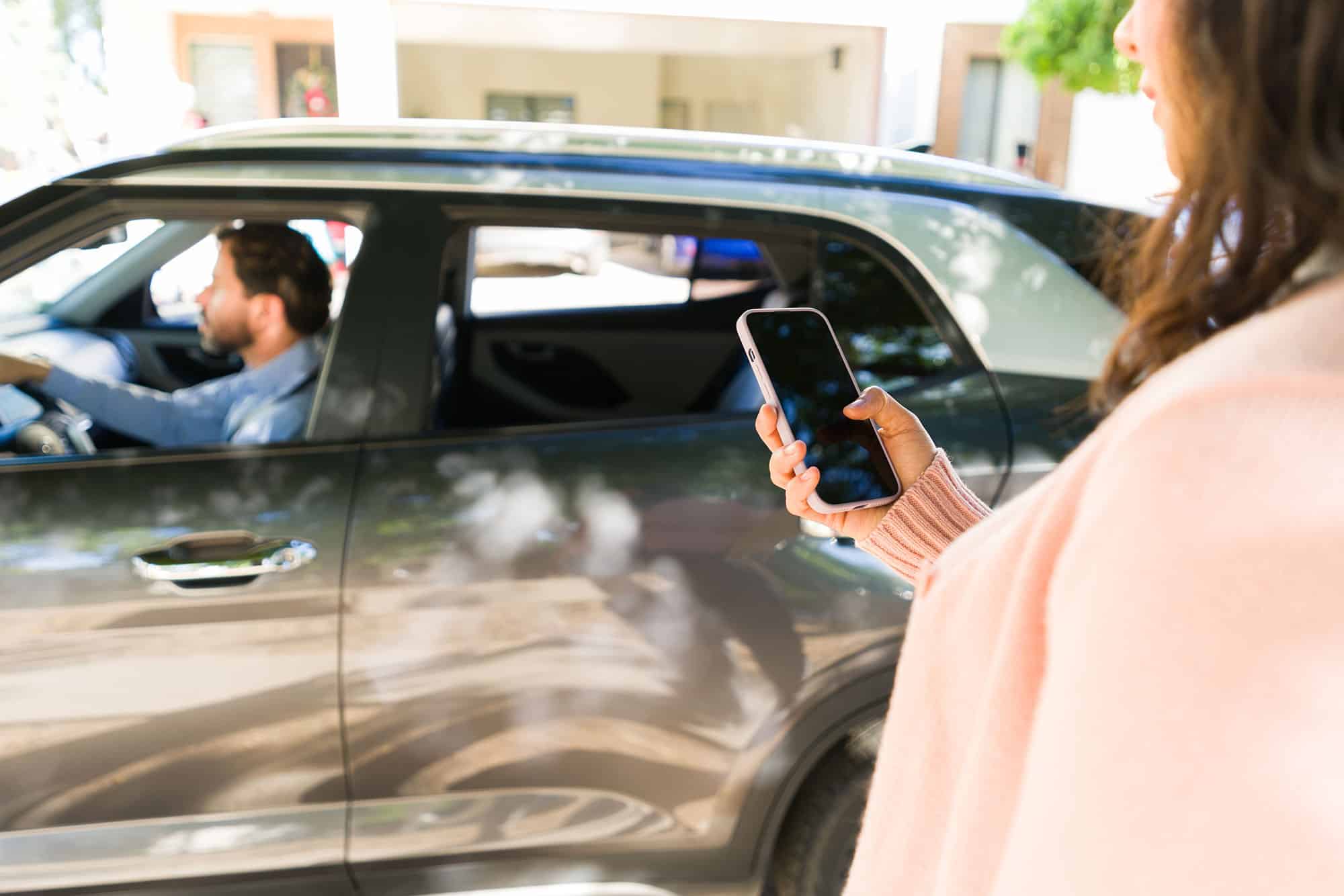
It is impossible to drive through Houston—whether you are navigating the relentless traffic on the Gulf Freeway, cruising down Westheimer, or heading through Pasadena—without sharing the road with the gig economy. They are everywhere: the Uber driver trying to find their passenger at Hobby Airport, the Amazon Flex driver rushing to drop a package in River Oaks, or the DoorDash delivery person checking their GPS while merging on I-45.
We have become addicted to the convenience of “on-demand” everything. But this convenience has birthed a complex, often dangerous new reality on Texas roads.
When a standard two-car accident happens between private citizens, the path to resolution, while stressful, is generally straightforward: you exchange information, file claims with personal auto insurance carriers, and determine fault.
But what happens when one of those vehicles is acting as a commercial entity one minute, and a private vehicle the next? What happens when the driver responsible for your catastrophic injury is technically not an “employee” of the multi-billion-dollar corporation they were working for?
If you have been injured in an accident involving a rideshare vehicle (Uber, Lyft) or an on-demand delivery service (DoorDash, Uber Eats, GrubHub, Amazon Flex, Instacart), you have not entered a standard personal injury claim. You have entered a legal maze designed by corporate lawyers to minimize payouts.
Trying to navigate this maze alone often leads to denied claims, low-ball settlement offers, and financial devastation. Here is an in-depth look at why these accidents are unique and why specialized legal representation is not a luxury—it is a necessity.
The Perfect Storm: Why Gig Workers Are Higher Risk
Before diving into the legal complexities, it is crucial to understand why these accidents are increasing in frequency and severity. The very nature of gig economy driving creates an environment ripe for negligence.
1. The Distraction Epidemic
The primary tool of a rideshare or delivery driver is their smartphone. To make a living, they must constantly interact with an app. They are accepting rides, declining low-paying offers, following in-app navigation (which is often notoriously flawed), and communicating with customers.
In Texas, we have laws against distracted driving. Yet, gig economy apps essentially require distracted driving to function. A driver looking at their phone to accept a DoorDash order is a driver whose eyes are off the road for crucial seconds.
2. The Pressure Cooker of “On-Demand”
Time is money in the gig economy. Delivery drivers are graded on speed; rideshare drivers lose income if they sit idle. This creates an immense financial pressure to speed, run yellow lights, make sudden illegal U-turns to catch a passenger, and drive aggressively.
3. Fatigue and Overwork
Unlike commercial truckers who have federally mandated rest breaks and hours-of-service logs, many gig economy drivers work massive hours—sometimes across multiple platforms simultaneously—to make ends meet. A fatigued driver cruising Houston highways at 2:00 AM after a 14-hour shift has unparalleled reaction times, making them a significant danger to themselves and others.
4. Unfamiliar Territory
Delivery drivers are frequently sent to neighborhoods, apartment complexes, or industrial parks they have never visited. Navigating unfamiliar streets while searching for house numbers creates erratic driving behavior—sudden braking, missed turns, and failures to yield.
The Core Legal Battle: Employee vs. Independent Contractor
If a FedEx truck hits you, the legal path is usually clear: FedEx is the employer, they own the truck, and under the doctrine of respondeat superior (let the master answer), the company is liable for the negligence of its employee while on the clock.
Rideshare and on-demand delivery giants have built their entire business models around avoiding this liability. They classify their drivers not as employees, but as “independent contractors.” They argue that they are merely technology platforms connecting a willing driver with a willing customer.
Why does this matter to your injury claim?
If a driver is just a contractor, the parent company (Uber, Lyft, DoorDash) will immediately argue that they are not legally responsible for the driver’s negligence. They will attempt to push all liability onto the driver personally.
The problem, of course, is that the individual driving a 2015 Toyota Camry to deliver tacos rarely has sufficient personal assets or insurance coverage to pay for a catastrophic injury involving spinal damage, traumatic brain injury, or long-term disability.
While some courts across the country are challenging this classification, in Texas, the independent contractor defense remains a powerful shield for these corporations. Overcoming it requires a sophisticated legal strategy that looks beyond just the driver’s actions.
The Insurance Maze: Understanding the "Periods" of Coverage
The single most confusing aspect of a rideshare or delivery accident is insurance. Who pays?
A personal auto insurance policy almost always contains a “business use exclusion.” This means if you use your personal car to carry people or property for a fee, your personal insurance is null and void. If a DoorDash driver hits you and tries to claim it on their personal GEICO policy, that claim will almost certainly be denied the moment GEICO learns they were delivering food.
To fill this gap, states like Texas have passed laws (such as House Bill 1733) mandating that Transportation Network Companies (TNCs) provide certain levels of coverage. However, this coverage is triggered in “periods” or “tiers,” depending on the exact status of the driver’s app at the moment of impact.
Determining which period applies is often the fiercest battleground in these cases.
Period 0: App is Off
The driver is using their car for personal reasons. The app is closed.
Coverage: Only the driver’s personal auto insurance applies. If they have state minimum limits (which many do), there may be very little money available for a serious injury. The corporate Uber/Lyft policy does not apply at all.
Period 1: The “Gap”—App is On, Waiting for a Request
The driver is logged in and cruising around Houston waiting for a ping, but has not accepted a ride or delivery yet. This is the most dangerous period for insurance coverage.
The Problem: The driver’s personal insurance will likely deny the claim because the app is on (business use). However, the rideshare company’s “full” policy hasn’t kicked in yet because there is no passenger.
Coverage: Texas law mandates contingent coverage from the TNC during this phase, but it is lower than full coverage. Typically, it provides $50,000 per person for bodily injury, $100,000 per accident, and $25,000 for property damage. While better than nothing, $50,000 evaporates instantly in a serious crash involving hospitalization and surgery.
Period 2: Request Accepted, En Route
The driver has accepted a ride or a delivery order and is driving to pick up the passenger or the food.
Period 3: Passenger or Goods on Board
The passenger is in the car, or the food is being transported to the customer.
Coverage for Periods 2 & 3: During these active phases, the TNC’s full commercial insurance policy is in effect. In Texas, Uber and Lyft typically provide $1 Million in third-party liability coverage. This covers damages the rideshare driver causes to others (passengers, other motorists, pedestrians). They also usually provide Uninsured/Underinsured Motorist (UM/UIM) coverage, which protects you if the rideshare car you are in is hit by an uninsured drunk driver.
The Delivery Twist: While rideshare insurance is now somewhat standardized due to state laws, delivery services (DoorDash, GrubHub, etc.) are murkier. Some provide excess liability coverage similar to Periods 2/3, but others try to deny coverage unless the driver’s personal insurance denies it first, creating a bureaucratic nightmare of finger-pointing adjusters.
Who Is the Victim? Different Scenarios, Different Challenges
The strategy for your case changes dramatically depending on your role in the accident.
1. The Rideshare Passenger
Generally, this is the “easiest” scenario for recovery, but still fraught with issues. As a passenger, you are almost certainly innocent of any fault. You are covered by the company’s $1 Million policy regardless of whether your Uber driver caused the crash or another vehicle hit you (thanks to UIM coverage).
The Challenge: The insurance company for Uber/Lyft will still try to lowball your damages. They will dispute the severity of your injuries and question whether your medical treatment was necessary.
2. The Other Motorist Hit by a Gig Driver
You are stopped at a red light on Westheimer, and a driver looking at their Lyft app rear-ends you.
The Challenge: Proving the “Period.” The driver might lie and say their app was off to avoid getting de-activated by the company. The corporate insurer will demand proof that the app was on and in Period 2 or 3 before unlocking the $1 Million policy. If they successfully argue it was “Period 1,” your recovery might be capped at $50,000.
3. Pedestrians and Cyclists
These are often the most devastating injuries. Delivery drivers rushing to find addresses frequently fail to see pedestrians in crosswalks or cyclists in bike lanes. The insurance dynamics are the same as for other motorists, but the injuries are usually catastrophic, requiring policy-limit demands.
4. The Gig Driver Themselves
This is perhaps the most tragic scenario. If you are driving for Uber or DoorDash and are injured in an accident that wasn’t your fault, you are in a precarious position.
You are likely not covered by Workers’ Compensation because you are an independent contractor.
If the at-fault driver is uninsured, you must rely on the TNC’s UIM coverage (if applicable to your phase) or your own personal injury protection (PIP).
If you were at fault, you may have no coverage at all for your own medical bills unless you purchased specific, expensive rideshare endorsement policies.
Why Legal Representation is Non-Negotiable in Gig Economy Cases
If you have read this far, you realize these are not simple fender-benders. The intersection of technology, contractor law, and multi-tiered insurance policies creates a situation where an unrepresented victim is almost guaranteed to leave money on the table.
Here is the tangible value a specialized personal injury attorney brings to these cases:
1. The Investigation: Subpoenaing the “Black Box” Data
The most critical evidence in a gig economy crash is digital. We need to know the exact millisecond the crash occurred and what the driver’s app status was at that moment.
- Was a ride accepted?
- How fast were they traveling according to the app’s GPS?
- Were they interacting with the screen at the time of impact?
Uber, Lyft, and DoorDash will hold onto this data tightly. They will not voluntarily give it to you. A skilled attorney will file the necessary legal motions to preserve and obtain this electronic data immediately before it is “routinely deleted.” This data is the smoking gun that proves which insurance period applies.
2. Cutting Through the Red Tape of Multiple Adjusters
In a typical rideshare crash, you might be dealing with three or four different insurance adjusters:
- The gig driver’s personal auto insurance.
- The rideshare company’s corporate insurance (e.g., Allstate, Progressive, or James River).
- The at-fault third party’s insurance (if another car caused the crash).
- Your own UIM/PIP carrier.
Every single one of these adjusters has one goal: to pay you as little as possible and shift responsibility to the other carriers. They will use recorded statements against you and delay proceedings hoping you get desperate and accept a low offer. Your attorney acts as the shield, handling all communication and preventing these carriers from manipulating you.
3. Accurately Valuing Complex Damages
Because rideshare insurance policies often have higher limits ($1 Million), they are appropriate for cases involving severe injuries. But accessing those limits requires proving the full extent of your damages.
An attorney does not just tally up your current medical bills. We work with medical experts and forensic economists to calculate:
- Future medical needs (surgeries, rehabilitation, pain management).
- Lost earning capacity if you cannot return to your previous job.
- Non-economic damages like pain and suffering, physical impairment, and mental anguish.
4. Holding the Corporation Accountable (Beyond the Driver)
While difficult, there are scenarios where the rideshare company itself can be sued for negligence, bypassing the contractor defense. Did they fail to conduct a proper background check, allowing a driver with a history of DWIs on the platform? Did they allow a vehicle that was clearly unroadworthy to continue operating? Did their app interface encourage reckless behavior in a specific instance? These are complex legal arguments that require deep knowledge of state regulations and emerging case law—arguments that an average person cannot make on their own.
Conclusion: Don't Fight Goliath Alone
The gig economy has changed the way we live in Houston, but it hasn’t changed the fundamental principle that if someone harms you through negligence, they should be held accountable.
Rideshare and delivery companies have armies of lawyers and adjusters working hard to protect their profits by minimizing your claim. They are counting on you not understanding the periods of coverage. They are counting on you giving up when faced with the initial denial from a personal auto policy.
If you or a loved one has been injured in an accident involving an Uber, Lyft, DoorDash, or any on-demand service vehicle, do not attempt to handle it alone. The stakes are too high, and the landscape is too treacherous. You need an advocate who understands the technology, the insurance loopholes, and the tactics these companies use. You need to level the playing field.
