

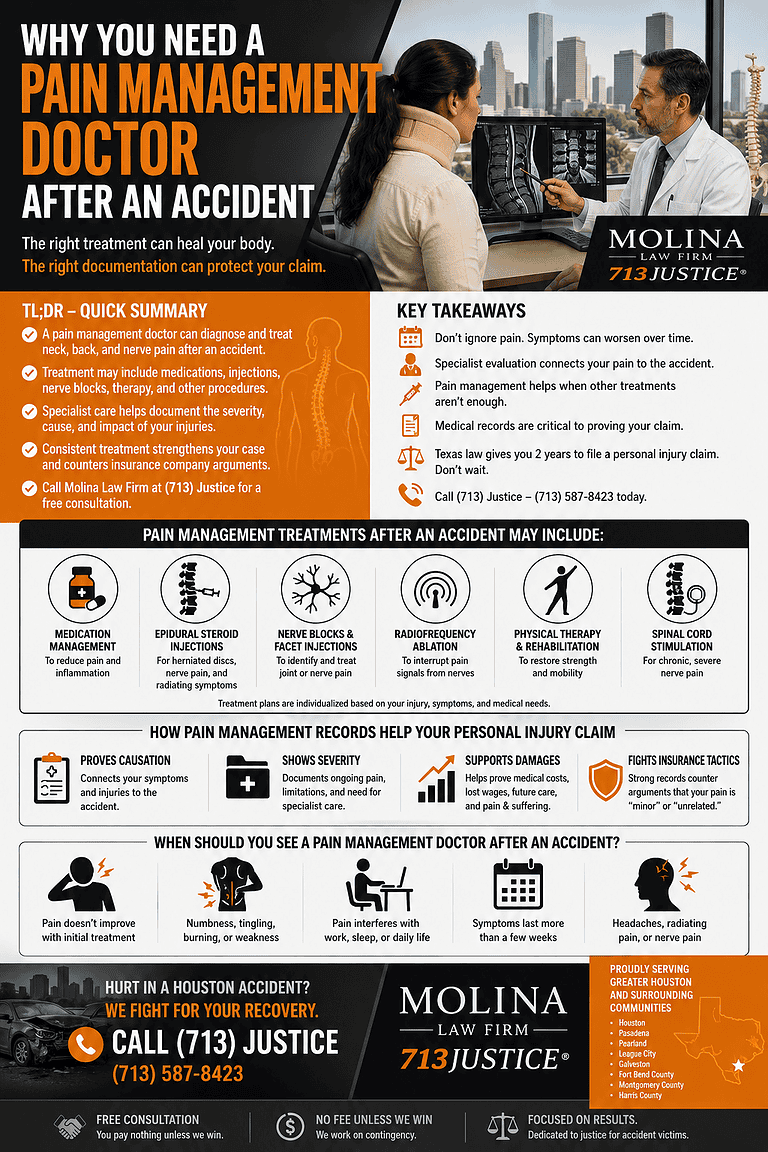
📋 TL;DR — Quick Summary ✔ Seeing a pain management doctor after an accident provides specialized treatment that goes beyond what an ER or primary care physician offers. ✔ Pain management doctors use epidural steroid injections, nerve blocks, facet joint injections, trigger point injections, and spinal cord stimulation to treat accident injuries. ✔ Seeing a pain management doctor after an accident creates detailed medical records essential to winning your personal injury claim. ✔ Insurance companies routinely use gaps in accident injury treatment to deny or reduce your compensation, consistent pain management care prevents that. ✔ Houston accident victims can access pain management treatment ✔ Texas has a 2-year statute of limitations for personal injury claims, don’t wait to get treatment and legal representation. ✔ Call Molina Law Firm at (713) JUSTICE — (713) 587-8423 for a free consultation today. #713Justice |
⚖️ KEY TAKEAWAYS FOR ACCIDENT VICTIMS 1. Seeing a pain management doctor after an accident is not optional if you have serious pain, it is one of the most important steps you can take for your health and your case. 2. Pain management doctors offer treatments far beyond pills, including injections, nerve blocks, and minimally invasive procedures that target the root cause of your pain. 3. Insurance companies look for gaps in medical treatment to argue that your injuries are not serious — consistent care with a pain management doctor shuts that argument down. 4. Houston has many qualified pain management doctors 5. The detailed records created by your pain management doctor become critical evidence in your personal injury lawsuit or insurance claim. 6. Do not live with pain if possible. If necessary, see a pain management specialist throughout Houston, Harris County, Pasadena, Deer Park, and the surrounding areas. |
If you have been hurt in a car accident, truck accident, or workplace incident on Houston’s busy roads — from I-10 East to the Gulf Freeway to the Beltway in Harris County — you may be asking yourself: do I need a pain management doctor after an accident? The short answer is almost certainly yes, and the reasons go far beyond simply managing your discomfort. A pain management doctor after an accident is a medical specialist trained to diagnose, treat, and document the kinds of musculoskeletal, nerve, and spinal injuries that commonly result from the trauma of a collision. These injuries are often invisible on initial ER scans, only revealing their full severity in the days and weeks following the crash. At the ER, you were likely evaluated for any broken bones. Seeing a pain management doctor after an accident will help you evaluate the sources of any lingering pain.
Seeing a pain management doctor after an accident accomplishes two critical goals simultaneously: it gets you the targeted, specialized treatment you need to actually recover — and it creates a detailed, chronological medical record that documents every symptom, every procedure, and every limitation your injuries have caused. In a personal injury case in Texas, that documentation is often the difference between a full financial recovery and a denied insurance claim.
Why Do I Need a Pain Management Doctor After an Accident in Houston?
Most accident victims start their medical journey in the emergency room or an urgent care clinic. While that immediate care is essential, ER physicians focus on identifying life-threatening conditions — broken bones, internal bleeding, traumatic brain injuries. They are not typically trained to diagnose and manage the chronic, complex pain syndromes that develop in the weeks and months after a crash. That is the exact role of a pain management specialist.
Pain management doctors — also called interventional pain specialists or physiatrists — hold advanced training in diagnosing the source of pain at the neurological and musculoskeletal level. They use diagnostic imaging, nerve conduction studies, and clinical assessment to identify the precise structures that are injured: a herniated disc pressing on a nerve root, an inflamed facet joint, a damaged sacroiliac joint, or a compressed spinal canal. Once the source is identified, they deploy a targeted arsenal of treatments — including injections, minimally invasive procedures, and comprehensive rehabilitation plans — to address the problem directly.
Why an ER Visit Alone Is Not Enough After a Houston Car Accident
After a crash on I-45 or the Sam Houston Tollway, you may walk out of Ben Taub Hospital or Memorial Hermann feeling like your injuries are minor. But conditions like disc herniations, soft tissue tears, nerve impingement, and spinal ligament damage often do not present their full symptom picture for 24 to 72 hours — or longer. An ER doctor who orders a standard X-ray will find broken bones but will almost never detect a herniated cervical disc or a torn ligament that is already beginning to cause nerve damage. A pain management doctor, using advanced MRI imaging and targeted neurological assessment, will find what the ER missed.
How a Pain Management Doctor Helps You Recover
Texas insurance adjusters are trained to look for weaknesses in personal injury claims — and one of their favorite tactics is pointing to a gap in medical treatment. If you stopped seeing a doctor for four weeks after your accident, the insurance company will argue that you must not have been seriously hurt. A pain management doctor creates a continuous, detailed medical record that closes those gaps. Every visit documents your pain levels, your functional limitations, your response to treatment, and your ongoing need for care. That record becomes the backbone of your personal injury lawsuit.
⚠️ CRITICAL: Insurance companies for at-fault drivers often try to contact accident victims quickly after a crash to get a recorded statement before the full extent of injuries is known. Do not give a recorded statement and do not accept a settlement offer before you have been fully evaluated by a pain management doctor. Call Molina Law Firm at (713) JUSTICE — (713) 587-8423 first. |
Common Accident Injuries That Require Pain Management Treatment in Texas
The type of crash determines the pattern of injuries — but Houston’s most common accident types tend to produce the same categories of serious injury that pain management doctors are best equipped to treat.
Whiplash and Cervical Spine Injuries from Houston Rear-End Crashes
Rear-end collisions are among the most common accidents on Houston freeways, particularly during stop-and-go congestion on I-10 West (the Katy Freeway), I-45, and US-59. When a vehicle is struck from behind, the sudden forward-and-back motion of the head — even at relatively low speeds — can strain or tear the ligaments and muscles of the cervical spine, damage intervertebral discs, compress nerve roots, and injure the facet joints of the neck. Whiplash injuries frequently require a combination of physical therapy, anti-inflammatory injections, and nerve block procedures offered exclusively in pain management settings.
Lumbar Disc Herniations and Lower Back Pain
The lumbar spine (lower back) is one of the most commonly injured regions in car accidents. The compressive forces of a frontal collision, a T-bone impact, or even a minor rear-end crash can cause intervertebral discs to bulge or herniate — pressing on the spinal cord or nerve roots and producing pain, numbness, tingling, and weakness that can radiate down the legs (a condition called radiculopathy, commonly known as sciatica). Lumbar disc herniations often require epidural steroid injections, medial branch blocks, or other interventional procedures to reduce inflammation and interrupt the pain signal.
Nerve Damage and Radiculopathy
Nerve injuries are among the most debilitating — and most often missed — consequences of a serious accident. Radiculopathy occurs when a damaged disc or inflamed joint compresses a spinal nerve root, sending pain, numbness, or weakness into the arms or legs. Pain management doctors use electromyography (EMG) and nerve conduction studies to diagnose nerve damage objectively — creating medical records that are extremely powerful evidence of the severity and permanence of your injuries.
Soft Tissue Injuries, Muscle Spasms, and Trigger Points
Soft tissue injuries — sprains, strains, muscle tears, and ligament damage — are the most common consequence of a motor vehicle accident. They are also among the most contentious injuries in a personal injury claim, because insurance companies often argue they are minor and temporary. Pain management doctors document the severity of soft tissue injuries through clinical findings and treat them with targeted trigger point injections, physical therapy protocols, and myofascial release techniques.
Types of Injections and Treatments Offered by Pain Management Doctors to Accident Victims
This section answers one of the most common questions we hear at Molina Law Firm: what exactly will a pain management doctor do for my accident injuries? Pain management specialists use a range of evidence-based, minimally invasive treatments to reduce pain, restore function, and help accident victims avoid unnecessary surgery.
Treatment | Injury Treated | Duration of Relief | Imaging Guided? |
Epidural Steroid Injection (ESI) | Herniated disc, nerve root compression, radiculopathy | Weeks to months | Yes (fluoroscopy) |
Facet Joint Injection | Facet joint arthritis, whiplash injury | Weeks to months | Yes (fluoroscopy) |
Medial Branch Block | Facet-mediated back/neck pain | Hours to weeks (diagnostic + therapeutic) | Yes (fluoroscopy) |
Nerve Block | Radiculopathy, neuralgia, nerve pain | Hours to months | Often yes |
Myofascial pain, muscle spasm | Days to weeks | No | |
SI Joint Injection | Sacroiliac joint dysfunction | Weeks to months | Yes (fluoroscopy) |
Radiofrequency Ablation | Chronic facet joint pain | 6–18+ months | Yes (fluoroscopy) |
Spinal Cord Stimulation | Severe, refractory chronic pain | Long-term (implanted device) | Yes (surgical guidance) |
Epidural Steroid Injections After a Car Accident: What You Need to Know
Epidural steroid injections (ESIs) are one of the most frequently used pain management treatments for accident victims with disc herniation or nerve root compression. During an ESI, a pain management doctor uses fluoroscopy (real-time X-ray guidance) or ultrasound to precisely place a needle in the epidural space — the area between the protective covering of the spinal cord and the vertebral bones. A corticosteroid medication, often combined with a local anesthetic, is then injected to reduce inflammation around the compressed nerve root. The procedure typically takes 15 to 30 minutes and can provide significant relief lasting weeks to months. For accident victims in active litigation, an ESI also produces detailed procedural records that document the severity of the underlying nerve or disc injury.
Nerve Blocks for Accident-Related Pain in Houston
Nerve blocks are injections of anesthetic — and sometimes steroid medication — that interrupt pain signals along specific nerves or nerve pathways. After a car accident, nerve blocks are commonly used to treat cervical (neck) radiculopathy, lumbar radiculopathy, occipital neuralgia (a painful condition affecting the nerves at the base of the skull that frequently results from whiplash), and sympathetically maintained pain conditions. Nerve blocks serve a dual purpose: they provide therapeutic relief, and they serve as diagnostic tools that confirm exactly which nerve or joint is the source of your pain — information that is also valuable evidence in your personal injury case.
Facet Joint Injections and Medial Branch Blocks for Spine Injuries
The facet joints are the small stabilizing joints that run along the back of the spine at each vertebral level. These joints are commonly injured in whiplash crashes and rear-end collisions. When a facet joint is inflamed or damaged, it produces a characteristic pattern of referred pain — neck pain that radiates into the shoulders and upper back, or lower back pain that radiates into the buttocks and hips. A pain management doctor can inject anesthetic and corticosteroid directly into the affected facet joint or block the medial branch nerve that transmits pain from the joint. If the medial branch block provides significant but temporary relief, the doctor may recommend radiofrequency ablation to destroy the pain-carrying nerve fiber and provide longer-lasting relief.
Trigger Point Injections for Muscle Pain After an Accident
Trigger points are tight, hypersensitive knots that form in muscle tissue following trauma. After a car accident, trigger points frequently develop in the muscles of the neck, upper back, shoulders, and lower back — producing persistent, aching pain that is aggravated by movement. A trigger point injection involves inserting a small needle directly into the trigger point and injecting a local anesthetic, sometimes combined with a corticosteroid. The procedure relaxes the contracted muscle, reduces inflammation, and interrupts the pain cycle. Many accident victims see significant improvement after a series of trigger point injections combined with physical therapy.
The Connection Between Houston’s Roads and the Need for Pain Management Care
Houston has some of the most accident-prone roadways in Texas. The Texas Department of Transportation (TxDOT) consistently identifies I-10, I-45, US-59, Beltway 8, and the Port of Houston access corridors as high-crash zones. With millions of daily vehicle miles traveled in Harris County alone, serious accidents produce a steady stream of injured drivers and passengers who need the kind of specialized, sustained medical care that only pain management doctors can provide. The musculoskeletal and nerve injuries that result from Houston traffic accidents — particularly those involving 18-wheelers, commercial trucks, and speeding drivers — are exactly the types of injuries that pain management specialists are trained to treat.
How Pain Management Records Impact Your Houston Personal Injury Case and Damages
Every procedure performed by your pain management doctor generates medical records — and in a personal injury case, those records are among the most powerful evidence your attorney can present.
Medical Records as Evidence of Pain and Suffering Damages
In Texas, personal injury victims can recover non-economic damages including physical pain and suffering, mental anguish, and loss of enjoyment of life. These damages are subjective — they cannot be proven with a receipt or a pay stub. What proves them are detailed medical records documenting your pain levels at each visit, your functional limitations, your sleep disturbances, your inability to participate in activities you previously enjoyed, and the impact of your injuries on your work and family life. A pain management doctor who documents all of these factors at every appointment is building the evidentiary foundation of your damages case.
Future Medical Expenses and the Role of Your Pain Management Doctor
Some accident injuries — particularly spinal injuries involving herniated discs, nerve damage, or facet joint destruction — do not resolve after a short course of treatment. They require ongoing care: repeat injections, periodic radiofrequency ablation procedures, physical therapy maintenance, or even surgical intervention. Texas law allows personal injury plaintiffs to recover not just past medical expenses, but also the cost of reasonably anticipated future medical care. A pain management doctor who provides a written opinion about your future treatment needs and projected costs gives your attorney the medical foundation to demand — and prove — future medical expenses as part of your damages.
What Should You Do After an Accident to Protect Your Health and Your Legal Rights in Texas?
The steps you take in the first days after a Houston accident are critical — both for your medical recovery and for the strength of your personal injury claim.
- Call 911 and seek emergency care. Even if you feel okay, get evaluated at an ER. Adrenaline can mask serious injuries. Establish a medical record immediately.
- Follow up with your primary care physician within 24–48 hours. Report all symptoms — even ones that seem minor. Ask for a referral to a pain management specialist if you have neck pain, back pain, numbness, tingling, or headaches.
- See a pain management doctor as soon as possible. Do not wait weeks or months. The sooner you receive a comprehensive evaluation and begin treatment, the stronger your medical documentation — and the better your chances of a full recovery.
- Attend every appointment. Inconsistent attendance in pain management treatment gives insurance companies ammunition to argue that you are not seriously injured. Follow your doctor’s plan completely.
- Keep a pain journal. Document your daily pain levels, activities you cannot perform, sleep disruptions, and emotional impacts. This contemporaneous documentation supports your non-economic damages.
- Contact Molina Law Firm at (713) JUSTICE. Call us as soon as possible after your accident. We will refer you to trusted pain management providers, send a preservation letter to protect evidence, and begin building your case immediately — at no cost to you unless we win.
📞 Injured in a Houston Accident? Call (713) JUSTICE Today. You deserve specialized medical care and aggressive legal representation. Molina Law Firm offers free consultations and works on contingency — you pay nothing unless we win. We can also connect you with pain management doctors who treat accident victims on a medical lien. (713) JUSTICE — (713) 587-8423 Available 24 hours a day, 7 days a week | #713Justice | Se Habla Español |
Frequently Asked Questions: Pain Management After an Accident in Houston
Q: Do I really need a pain management doctor after a car accident, or is my regular doctor enough?
A primary care physician can treat many common injuries, but pain management doctors are specialists in the complex, chronic pain conditions that frequently result from accident trauma — herniated discs, nerve compression, facet joint injuries, and myofascial pain syndromes. For anything beyond minor bruising or soreness, a pain management doctor’s advanced diagnostic tools and minimally invasive treatments will produce better medical outcomes and stronger documentation for your legal case. At Molina Law Firm, we strongly recommend that all accident victims with persistent pain be evaluated by a pain management specialist as soon as possible.
Q: How soon after my accident should I see a pain management doctor?
As soon as possible — ideally within the first week after your accident if you have ongoing pain, limited range of motion, or neurological symptoms like numbness or tingling. The longer you wait, the more ammunition the insurance company has to argue that your injuries are not serious or not related to the accident. Many pain management doctors in the Houston area who work with accident victims can schedule initial evaluations quickly. Molina Law Firm can facilitate a referral immediately.
Q: What types of injections do pain management doctors give to car accident victims?
Pain management doctors use a range of injection-based treatments for accident injuries, including: epidural steroid injections (ESIs) for disc herniations and nerve compression; facet joint injections for spine joint injuries; medial branch blocks for facet-mediated pain; nerve blocks for radiculopathy and neuralgia; trigger point injections for muscle pain and spasm; and sacroiliac (SI) joint injections for pelvic and lower back pain. For patients with chronic pain, radiofrequency ablation may be used to provide longer-lasting relief, and in severe cases, spinal cord stimulation may be recommended.
Q: Will having a pain management doctor help me get more money in my Houston personal injury case?
Yes, in most cases. Consistent, documented pain management treatment strengthens your personal injury claim in two ways. First, it demonstrates the seriousness and duration of your injuries — countering insurance company arguments that your pain is minor or temporary. Second, your pain management records create a detailed account of your suffering, your functional limitations, and your medical needs that directly supports your claims for both economic damages (medical bills, lost wages) and non-economic damages (pain and suffering, mental anguish). Accident victims who receive consistent pain management care typically recover significantly more than those who do not.
Q: How long does pain management treatment last after a car accident?
The duration of pain management treatment depends entirely on the nature and severity of your injuries. Some patients achieve significant relief after a short course of injections and physical therapy — a matter of months. Others with more serious injuries — severe disc herniations, significant nerve damage, or multiple spinal levels involved — may require ongoing pain management care for years or permanently. Your pain management doctor will provide a treatment plan and prognosis based on your specific injuries, which becomes important evidence in your personal injury case when claiming future medical expenses.
Q: What is the statute of limitations for a personal injury claim in Texas?
Under Texas Civil Practice and Remedies Code § 16.003, you have two years from the date of your accident to file a personal injury lawsuit in Texas. Missing this deadline almost always means permanently losing your right to compensation. Do not wait — begin your medical treatment and contact Molina Law Firm as soon as possible after your accident.
Molina Law Firm
11550 Fuqua St., Suite 580, Houston, TX 77034
Phone: (713) JUSTICE / (713) 587-8423 | info@molinalawfirm.com
Serving Harris County, Fort Bend County, Montgomery County, Galveston County, and the Greater Houston Metropolitan Area
#713Justice
Related Links
- WRONGFUL DEATH:
- What Happens When An Unlicensed Driver Causes a Fatal Accident?
- Hit and Run Accidents
- Houston Wrongful Death Accident Claims
- Houston Wrongful Death Head-On Collisions
- Houston Wrongful Death Accident Attorney
- CAR ACCIDENTS:
- Experienced Houston Car Wreck Attorney
- Car Travel With Dogs
- Accidents, Emergency Rooms, and Urgent Care
- Houston Wrong Way Driving Accident Lawyer
- Texas Negligent Entrustment Claims
- Houston Auto Accident Attorney
- Accident Lawyers
- Rideshare Accidents
- Houston Chain Reaction Car Accident
- Houston Hit and Run Accident Lawyer
- Houston Teen Driving Accidents
- SAGEMONT ACCIDENT & INJURY:
- Sagemont Accidents
