

If you’ve spent more than twenty minutes behind the wheel in Houston, you know the “Space City” sometimes feels more like a scene out of a high-speed chase movie. Between the sprawling interchanges of the 610 Loop and the relentless pace of the Katy Freeway, driving here is an exercise in high-alert vigilance. But while our massive highways get most of the notoriety, the real danger often lies where the concrete meets the community: our intersections. The 713Justice personal injury team is Molina Law Firm, located in Houston Texas. If you have a personal injury case that you think needs to be fought in court, call us at (713) JUSTICE/ (713) 587-8423.
As we move past 2025, the data paints a sobering picture of our local roadways. Despite technological advances in vehicle safety and city-led initiatives like Vision Zero, which aims to eliminate traffic fatalities by 2030, the numbers suggest we still have a long way to go. In 2024, Houston recorded a record-shattering 345 traffic deaths—a 15% increase from the year prior. A staggering portion of these incidents, and over 60,000 total crashes, occurred at intersections. This report dives into the specific crossroads that are currently the most hazardous for Houstonians and examines why these spots remain so notoriously difficult to navigate.
The Statistical Landscape of 2025
To understand where we are going, we have to look at where we’ve been. According to the Texas Department of Transportation (TxDOT) and the Houston Police Department, intersection-related accidents now account for roughly 40% of all traffic collisions in the city. This isn’t just about “fender benders” in a grocery store parking lot; these are high-impact, life-altering events.
The 2024 year-end data, which informs our 2025 safety outlook, shows that speeding remains the primary culprit, contributing to 35% of fatal accidents. Distracted driving follows closely behind, linked to 20% of all crashes. In a city where “feeder roads” often have speed limits of 45 or 50 mph, a single second spent looking at a phone while approaching a red light can be the difference between a safe stop and a catastrophic T-bone collision.
The "Crown Jewels" of Danger: Houston’s Highest-Risk Crossroads
While every intersection carries risk, a few specific locations in Houston consistently top the charts for crash frequency and severity.
Bissonnet Street and Beltway 8
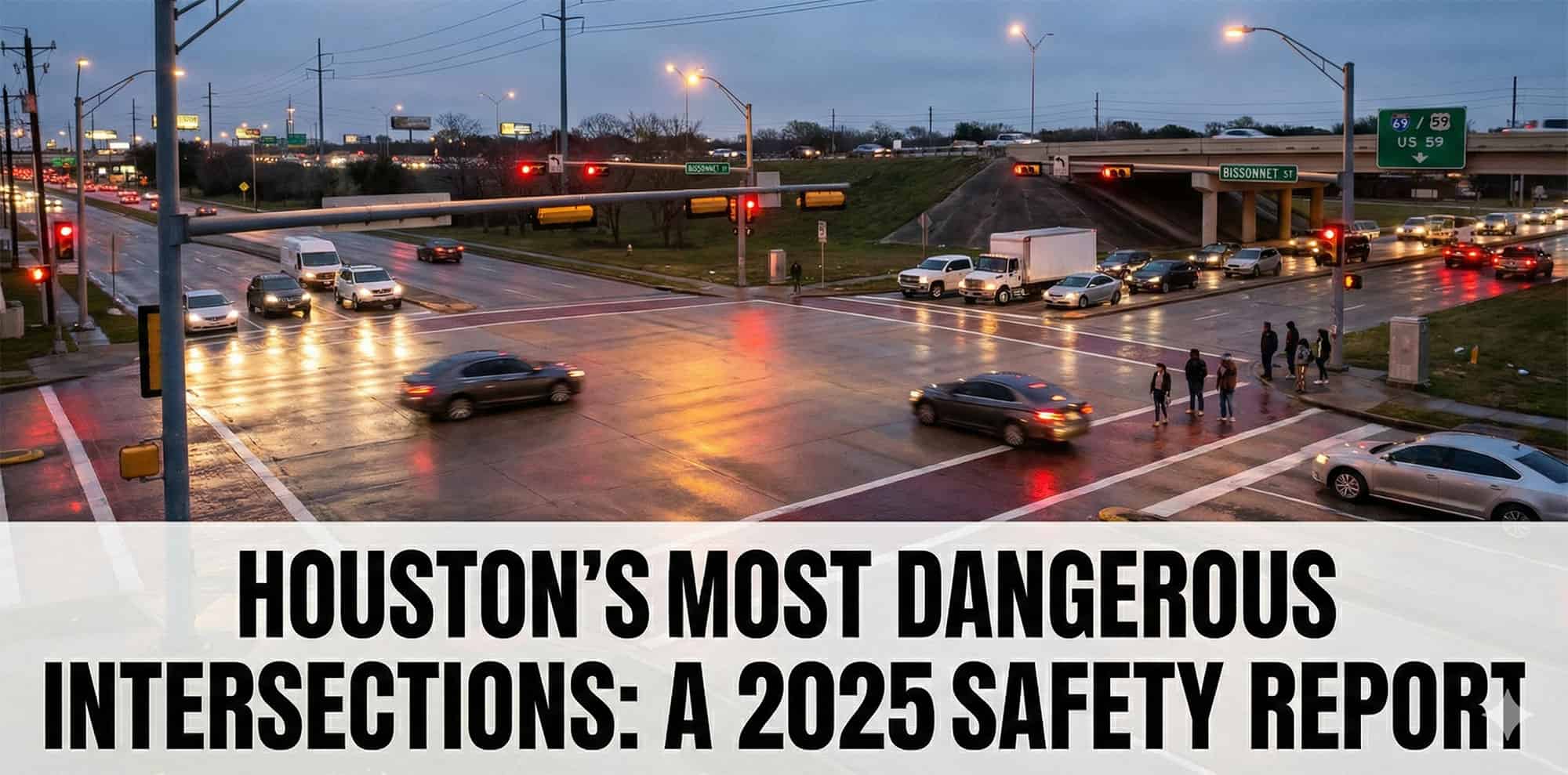
For years, the intersection of Bissonnet and Beltway 8 has been a permanent fixture on “most dangerous” lists, and 2025 is no different. Located in Southwest Houston, this junction saw over 220 crashes in the last reporting cycle. Why is it so bad? It’s a classic example of what urban planners call a “stroad”—a hybrid between a street and a road.
Bissonnet is lined with commercial shopping centers, residential complexes, and a constant stream of pedestrians. However, the traffic moves at speeds typical of a highway. The complex signal patterns and high volume of drivers attempting to turn into retail parking lots create constant “conflict points.” When you combine high-speed through-traffic with slow-moving vehicles attempting to turn, you get the perfect recipe for T-bone accidents and rear-end collisions.
FM 1960 and West Lake Houston Parkway
Moving to the Northeast, the intersection of FM 1960 and West Lake Houston Parkway remains a massive headache for Lake Houston area residents. With roughly 200 reported crashes annually, this area struggles with the sheer volume of suburban growth. This intersection serves as a primary artery for commuters, shoppers, and heavy commercial trucks. The infrastructure, while frequently under construction, has struggled to keep pace with the thousands of new residents moving to the area. The “stop-and-go” nature of FM 1960, coupled with frequent lane changes by drivers trying to reach specific storefronts, leads to a high frequency of multi-vehicle pile-ups.
Pease Street and Fannin Street
Downtown Houston offers its own unique brand of danger. Unlike the sprawling suburban intersections, Pease and Fannin is a dense, high-activity urban crossroads. This location is notorious for being a “distraction trap.” Drivers are often navigating one-way streets, looking for parking, or following GPS directions through the tall buildings of the central business district. Pedestrian traffic here is some of the highest in the city, and the data shows that failure to yield to walkers is a primary factor in accidents at this location.
The "Stroad" Problem and the Feeder Road Paradox
To understand why Houston intersections are so uniquely dangerous, you have to understand the way our city is built. Houston is famous for its feeder roads (or service roads), which are a rarity in many other parts of the country. These roads allow high-speed traffic to exit a freeway and immediately interact with local businesses, driveways, and cross-streets.
The “Feeder Road Paradox” is simple: we have roads designed for 50 mph traffic that also have to handle U-turns, pedestrians crossing to bus stops, and cars pulling out of fast-food drive-thrus. This creates a massive disparity in vehicle speeds. At an intersection like Westheimer and the Sam Houston Parkway, you might have one car traveling at 10 mph looking for an address and another traveling at 55 mph trying to catch a yellow light. That 45-mph speed differential is what turns a minor mistake into a fatal crash.
The Human Toll: Pedestrians and Vulnerable Road Users
One of the most concerning trends in the 2025 report is the continued rise in pedestrian fatalities. In 2024, 119 pedestrians were killed on Houston streets. The data suggests that more than half of these deaths occurred on roads with speed limits of 45 mph or higher.
Many of Houston’s most dangerous intersections lack adequate lighting and protected crosswalks. Locations like Gessner Road at Westview Drive or Main Street at Pierce Street have become flashpoints for pedestrian-vehicle conflicts. For those relying on public transit, the walk to and from the bus stop often requires crossing six to eight lanes of high-speed traffic. When drivers are focused on their phones or rushing to beat a light, they often fail to notice a person in the crosswalk until it is too late.
Why 2026 Feels Different: The Impact of Construction
Houston is in a state of perpetual renovation. As we move past 2025, major projects like the I-610/I-69 interchange improvement and the ongoing I-45 expansion are fundamentally changing traffic patterns.
Construction zones create temporary intersections and “shifting” lanes that confuse even the most seasoned local drivers. When lane markings are ground off and replaced with temporary tape, or when a familiar exit is suddenly closed, drivers tend to make sudden, erratic maneuvers. Our data shows a spike in side-swipe accidents near these construction corridors, particularly where feeder roads are narrowed to accommodate equipment.
The Absence of Red-Light Cameras
A significant factor in the current safety climate is the 2019 statewide ban on red-light cameras in Texas. While the move was popular for those concerned about privacy and “revenue traps,” traffic safety advocates point to a noticeable increase in red-light running at major intersections. Without the threat of an automated ticket, many drivers have become more aggressive during the “yellow-to-red” transition. This behavior is a direct contributor to the increase in high-speed T-bone collisions, which are among the most lethal types of accidents due to the lack of “crumple zones” on the sides of vehicles.
Safety Recommendations for Houston Drivers
Navigating these hotspots doesn’t have to be a gamble. While we wait for infrastructure improvements, individual behavior remains the most effective tool for staying safe.
- The Three-Second Rule at Green Lights: When the light turns green at a major intersection like Bissonnet or Westheimer, don’t immediately floor it. Take three seconds to look left, right, and left again. “Red-light runners” are most common in the first few seconds of a light change.
- Assume You Are Invisible: Whether you are driving a car or walking across the street, assume the other person doesn’t see you. This “defensive mindset” is essential in high-distraction environments like Downtown or the Galleria.
- Avoid the “Suicide Left”: If you are at an intersection without a protected left-turn arrow, and the traffic is heavy, it is often safer to drive through the intersection and make three right turns or use a dedicated U-turn lane further down the road.
- Check Your Blind Spots in Construction Zones: With lanes narrowing and shifting daily on the 610 Loop, your mirrors may not tell the whole story. A physical head-check is mandatory before any lane change.
The Legal Reality of Intersection Accidents
If you do find yourself involved in a collision at one of these notorious locations, the legal landscape in Texas is complex. We operate under a “modified comparative negligence” system. This means that if you are found to be more than 50% at fault for the accident, you cannot recover damages from the other party.
Insurance companies are well aware of which intersections are “trouble spots,” and they will often try to use the chaotic nature of these locations to shift blame onto you. Documenting the scene is crucial. In the age of 2026, many businesses near these intersections have high-definition surveillance, and many drivers have dash cams. Securing this footage immediately is often the difference between a successful claim and a denied one.
Looking Ahead: Can We Reach Vision Zero?
The 2025 Safety Report shows that Houston is at a crossroads—literally and figuratively. The city’s commitment to the Vision Zero Action Plan is a step in the right direction, with plans for better lighting, narrower lanes to naturally slow traffic, and more “pedestrian islands.” However, infrastructure takes years to build, while driver behavior can change in an instant.
As we look at 2026, the goal of zero traffic deaths by 2030 feels ambitious, perhaps even impossible, given the current trajectory. But every life saved at an intersection like Bissonnet or FM 1960 is a victory. Safety isn’t just a policy—it’s a collective responsibility. Whether you’re a commuter, a commercial trucker, or a pedestrian, staying informed about where the risks are highest is the first step toward making Houston’s roads safer for everyone.
Stay alert, stay off your phone, and remember: no destination is worth a life.
