
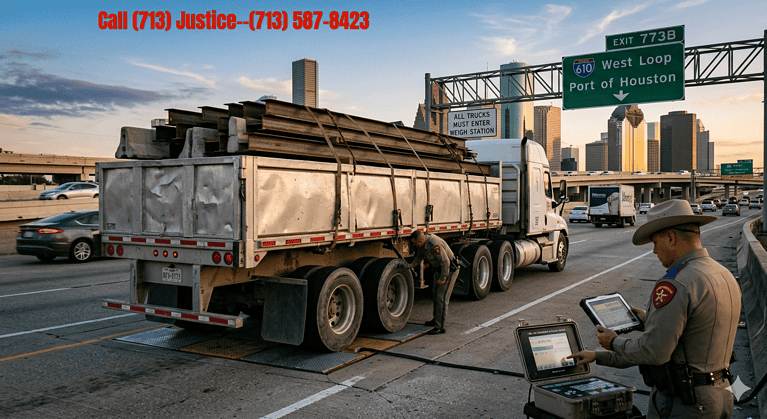
 TL;DR — Quick Summary
When an 18-wheeler exceeds Texas weight limits, it becomes exponentially more dangerous — and the trucking company may be legally liable for any resulting accident. Here’s the short version of what you need to know:
- Federal law caps most 18-wheelers at 80,000 lbs gross vehicle weight.
- Texas follows federal limits on interstates and imposes additional per-axle limits on state roads.
- Overweight trucks take longer to stop, cause more severe crashes, and damage Houston roads and bridges.
- Weight violations can be powerful evidence of negligence in a Texas truck accident lawsuit.
- Overweight truck accidents cause injuries that are often permanent
- If you were hit by an overweight truck in Houston or Harris County, call (713) Justice — (713) 587-8423 — for a free consultation.
 Key Takeaways for Accident Victims
- Weight limit violations are federal and state law violations — not just traffic infractions.
- Trucking companies are required to maintain weight and inspection records — these are critical evidence in your lawsuit
- Multiple parties may be liable: the driver, the trucking company, the shipper, and the cargo loader.
- Evidence preservation is urgent — trucking companies often destroy records quickly after a crash.
- Texas has a 2-year statute of limitations for personal injury claims — do not wait to speak with an attorney.
Every day, thousands of massive 18-wheelers rumble through Houston on I-10, I-45, the Ship Channel, the Beltway, and the Port of Houston access roads. Houston is one of the most freight-intensive in the country — and that volume of truck traffic comes at a cost. When a trucking company pushes its vehicle beyond the legal weight limit, the consequences for everyday drivers can be catastrophic.
At Molina Law Firm, we represent injured Houstonians and Harris County residents who have been hurt in serious 18-wheeler overweight accidents. One of the most commonly overlooked causes of 18-wheeler crashes is overloading. Understanding Texas 18-wheeler weight limits isn’t just regulatory trivia — it can be the difference between a denied insurance claim and a full financial recovery for your injuries.
What Are the Legal Weight Limits for 18-Wheelers in Texas?
Texas enforces both federal and state weight limits on commercial motor vehicles (CMVs). These rules exist to protect roads, bridges, and the safety of every driver sharing the road with these massive vehicles.
Federal Weight Limits on Interstate Highways
Under federal law (23 U.S.C. § 127), all states that receive federal highway funding — including Texas — must enforce the following minimum weight limits on the Interstate Highway System:
- Single axle: 20,000 lbs
- Tandem axle: 34,000 lbs
- Gross vehicle weight (GVW): 80,000 lbs
These limits apply on major Houston-area interstates including I-10 (the Katy Freeway), I-45, I-59, I-610 (the Loop), Beltway 8, 225 highway, 146, and US-290.
Texas State Weight Limits on Non-Interstate Roads
On Texas Farm-to-Market roads, state highways, and county roads, the Texas Transportation Code and the Texas Department of Motor Vehicles (TxDMV) impose additional weight restrictions that are often more stringent than federal limits. This includes roads commonly used by trucks in Harris County, Galveston County, Fort Bend County, and Montgomery County.
Key Texas-specific limits include:
- Maximum single axle weight: 20,000 lbs
- Maximum tandem axle weight: 34,000 lbs
- Tri-axle groups: 42,000 lbs
- Texas Gross Weight Formula limits that vary based on axle spacing
Texas Weight Limit Table at a Glance
Weight Category | Maximum Weight Limit |
Single Axle | 20,000 lbs |
Tandem Axle | 34,000 lbs |
Gross Vehicle Weight (GVW) | 80,000 lbs (federal standard) |
Texas Permit Weight | Up to 254,300 lbs (with permit) |
Steer Axle | 20,000 lbs |
Note: Oversize/overweight (OS/OW) permits issued by TxDMV may allow heavier loads in limited circumstances, but these permits require advance planning, escort vehicles, route approvals, and strict compliance with permit conditions.
Why Do 18-Wheeler Weight Limits Exist?
The Physics of a Loaded 18-Wheeler
A fully loaded semi-truck traveling at highway speeds carries an enormous amount of kinetic energy. The stopping distance of a 40-ton truck traveling at 65 mph can exceed 500 feet — nearly the length of two football fields. When that truck is overloaded, stopping distances grow even longer, brake systems are pushed beyond design limits, and tires become more prone to blowouts.
On Houston freeways where traffic can stop suddenly — especially on the notoriously congested I-10 or the I-45 Gulf Freeway — an overloaded truck is a rolling hazard for everyone nearby.
Infrastructure Protection: Houston’s Roads and Bridges
Beyond crash safety, weight limits exist to protect infrastructure. Houston’s bayou crossings, overpasses, and the many bridges along the Port of Houston and the Ship Channel corridor are engineered to handle specific load tolerances. Overweight trucks accelerate road deterioration, damage bridge structures, and contribute to the pothole-ridden roads that Harris County residents know all too well.
When a truck is overweight, it may also be in violation of bridge posting laws — signs that legally restrict vehicle weight on specific structures. Ignoring posted bridge weight limits is an independent violation that may support a negligence per se claim in litigation.
Why Are There So Many OverWeight Truck Accidents on Houston Highways?
Brake Failure and Extended Stopping Distance
The braking system on a commercial truck is designed to handle a maximum gross vehicle weight. When a truck exceeds that weight, the brakes work harder, generate excess heat, and are more likely to fade or fail entirely. Brake failure is one of the leading causes of rear-end truck accidents on Houston highways.
Tire Blowouts
Overloaded trucks place excessive stress on their tires. A blowout at freeway speed can cause the driver to lose control instantly — sending the trailer jackknifing across multiple lanes of traffic. Tire debris on the roadway poses an independent hazard to following vehicles.
Rollover Crashes
A higher center of gravity and excess weight make overloaded trucks significantly more likely to roll over, especially on curved ramps and highway interchanges. Houston’s freeway system includes numerous elevated interchanges — including the complex stack interchanges downtown — where rollovers can be particularly catastrophic.
Load Shifts and Cargo Spills
When cargo is overloaded or improperly secured, it can shift during transit. A sudden weight shift can cause a driver to lose control, or cargo can spill onto the roadway, creating serious hazards for other vehicles.
Structural Failures
Overweight loads can stress frame components, axle assemblies, and coupling systems beyond their design specifications, leading to sudden structural failures that result in accidents with little to no warning.
How does the Port of Houston impact overweight truck traffic?
The Port of Houston is one of the busiest in the nation. This leads to a high concentration of “Heavy-Haul” corridors nearby. While Texas does issue Overweight/Oversize (OW/OS) Permits for specific routes, many trucking companies cut corners to increase profit margins. They may bypass weigh stations or fail to secure the proper permits for crossing Harris County, putting local drivers at risk.
Who Is Responsible For 18-Wheeler OverWeight Truck Accidents?
Texas personal injury law allows victims to pursue claims against every party whose negligence contributed to a truck accident. In overweight truck cases, potential defendants may include:
The Truck Driver
Drivers are required to verify the weight of their load before departing and are responsible for complying with all weight limits. A driver who knowingly operates an overweight vehicle may be personally liable.
The Trucking Company
Motor carriers are vicariously liable for the acts of their drivers under respondeat superior. Beyond vicarious liability, a trucking company may be independently negligent if it pressured drivers to haul overweight loads, failed to weigh vehicles, ignored violations in its safety records, or failed to maintain its vehicles in a condition capable of safely handling heavy loads.
The Shipper / Cargo Loader
The entity that loaded the cargo is responsible for accurate weight declarations and secure loading. If a shipper provided false weight certifications or overloaded a trailer beyond its capacity, it may be a direct defendant in your lawsuit.
Third-Party Maintenance Contractors
If the truck’s brakes, tires, or other components failed because of inadequate maintenance — especially given the excessive stress of carrying overweight cargo — a third-party maintenance company may share liability.
Identifying all potentially liable parties is one of the most important strategic steps in an 18-wheeler accident case. Molina Law Firm investigates every angle to maximize your recovery.
How Can You Prove a Truck Was Overweight After an Accident in Houston?
Weigh Station and Scale Ticket Records
Commercial trucks are required to stop at weigh stations, and those records are maintained by the Texas Department of Transportation (TxDOT). Scale tickets may show that a truck was overweight before the accident — powerful evidence in litigation.
Electronic Logging Devices (ELDs) and Onboard Computers
Modern commercial trucks are equipped with electronic systems that track speed, braking events, load data, and route history. These systems can preserve evidence of dangerous driving behavior in the moments before a crash.
Bill of Lading and Freight Documents
The bill of lading describes the cargo, its declared weight, and the origin and destination of the shipment. Discrepancies between declared and actual weight are strong evidence of negligence.
Post-Crash Inspection Reports
Federal Motor Carrier Safety Administration (FMCSA) regulations require post-crash inspections for serious truck accidents. These inspection reports often document weight violations, equipment defects, and regulatory noncompliance.
Black Box / Event Data Recorder (EDR)
Like automobiles, most modern 18-wheelers have an EDR — commonly called a black box — that captures pre-crash data including vehicle speed, brake application, and engine performance. This data can directly corroborate or refute a truck driver’s account of events.
 CRITICAL: Preserve Evidence Immediately. Trucking companies and their insurers send rapid-response teams to crash scenes. These teams are tasked with protecting the company — which can include preserving evidence that helps them, and allowing harmful evidence to be destroyed. A preservation letter (spoliation letter) from your attorney can legally obligate the trucking company to retain all records. Call Molina Law Firm at (713) Justice — (713) 587-8423 — immediately after a serious truck accident.
What Texas Laws Govern 18-Wheeler Weight Limits and Violations?
Texas Transportation Code Chapter 621
Chapter 621 of the Texas Transportation Code establishes the weight and dimension limits for vehicles operating on Texas public roads. It sets axle weight limits, overall gross weight limits, and establishes the authority of TxDOT and law enforcement to weigh vehicles and issue citations.
Texas Transportation Code Chapter 623 — Oversize/Overweight Permits
Chapter 623 governs the permit system that allows certain vehicles to legally exceed standard weight limits. Permits are issued by TxDMV and require compliance with specific conditions. A truck operating without the required permit — or operating outside permit conditions — is in clear violation of Texas law.
Federal Motor Carrier Safety Regulations (FMCSRs)
The FMCSA, under the U.S. Department of Transportation, issues regulations that govern all aspects of commercial trucking safety. These include requirements for weight compliance, cargo securement (49 CFR Part 393), driver qualifications, hours of service, and vehicle maintenance. Violations of FMCSRs can support negligence per se claims — meaning the violation of a safety regulation is treated as automatic evidence of negligence.
Texas Civil Practice and Remedies Code — Negligence Per Se
Under Texas law, violating a statute designed to protect a class of persons from a particular type of harm constitutes negligence per se. If a trucking company violated weight limit laws — laws designed to prevent exactly the type of crash that injured you — that violation may establish negligence without requiring you to prove the defendant acted unreasonably.
What Damages Can You Recover in a Texas 18-Wheeler Weight Violation Case?
Texas law allows injured plaintiffs to pursue a broad range of compensatory damages. In cases involving serious violations like overweight truck operation, punitive damages may also be available if the conduct was grossly negligent.
Economic Damages
- Past and future medical expenses (emergency care, surgery, hospitalization, rehabilitation, physical therapy)
- Lost wages and loss of earning capacity
- Property damage to your vehicle
- Future home care or assisted living costs
- Out-of-pocket expenses related to your injuries
Non-Economic Damages
- Physical pain and suffering
- Mental anguish and emotional distress
- Disfigurement
- Physical impairment
- Loss of consortium (for your spouse or family members)
- Loss of enjoyment of life
Exemplary (Punitive) Damages
Under Texas Civil Practice and Remedies Code § 41.003, exemplary damages may be awarded when the defendant’s conduct rises to the level of gross negligence — meaning the defendant knew their conduct created an extreme risk of serious harm but proceeded anyway. A trucking company that repeatedly overloaded trucks despite prior violations, inspection failures, or driver complaints may be exposed to punitive damages.
How Does Houston’s Geography Create Unique Risks from Overweight Trucks?
Houston presents a unique risk environment for overweight truck accidents. As the fourth largest city in the United States and home to the nation’s largest petrochemical complex along the Ship Channel, Houston’s roads bear an extraordinary volume of heavy freight traffic.
High-Risk Corridors in Harris County
- I-10 East (the Katy Freeway and East Freeway) — one of the widest and most truck-heavy highways in America
- I-45 South (Gulf Freeway) — a major port access route with heavy container truck traffic
- Beltway 8 (Sam Houston Tollway) — a critical freight bypass route around the city
- Texas State Highway 225 — directly serving the Ship Channel petrochemical corridor
- US-90 and US-59 — major commercial corridors through Pasadena, Deer Park, and La Marque
- The Port of Houston access roads — among the most congested and freight-intensive in the state
Houston’s Weather and Overweight Trucks
Houston’s notoriously heavy rainfall creates additional hazards when overweight trucks are involved. Extended stopping distances become even more dangerous on wet roadways — and Houston’s frequent flooding events can obscure road markings, lower speed limits, and compromise road surfaces in ways that make overweight trucks even more difficult to control.
What Should You Do If You Were Hit by an Overweight 18-Wheeler in Texas?
- Call 911 and get emergency medical care. Always seek medical attention immediately after a truck accident — even if you feel fine. Symptoms of serious injuries like traumatic brain injury, internal bleeding, and spinal damage can be delayed.
- Document the scene if it is safe to do so. Take photos and videos of the vehicles, road conditions, the truck’s license plate and DOT number, cargo, and any visible damage.
- Get witness contact information. Eyewitness accounts from other drivers can be invaluable in reconstructing what happened.
- Do not give a recorded statement to the trucking company’s insurer. Insurance adjusters are trained to minimize your claim. Anything you say can and will be used against you.
- Contact a Houston truck accident attorney immediately. The faster your attorney can send a preservation letter and begin investigating, the better your chances of recovering critical evidence.
Frequently Asked Questions About 18-Wheeler Weight Limits in Texas
Q: What is the maximum weight for an 18-wheeler in Texas?
A: On Interstate highways in Texas, the federal gross vehicle weight limit is 80,000 lbs. On Texas state roads, the limit is determined by a combination of axle weight limits and the Texas Gross Weight Formula, which factors in axle spacing. With an oversize/overweight permit from TxDMV, certain vehicles can legally exceed standard limits, but only with advance approval and strict compliance with permit conditions.
Q: Can I sue a trucking company if their truck was overweight and caused my accident?
A: Yes. If an overweight 18-wheeler caused your accident and injuries, you may have claims against the trucking company, the driver, the shipper, and other parties. Weight limit violations can constitute negligence per se under Texas law, meaning the violation itself may establish the defendant’s negligence. Molina Law Firm can evaluate your case and explain all of your legal options.
Q: How do I find out if the truck that hit me was overweight?
A: Evidence of overweight operation can be found in weigh station records, DOT inspection reports, the truck’s bill of lading, onboard electronic logging device (ELD) data, and post-crash investigation reports. Your attorney can send legal preservation demands and subpoenas to obtain these records before they are destroyed. Acting quickly is essential.
Q: Does Texas have different weight limits than federal law?
A: Texas follows federal weight limits on Interstate highways. On state and local roads, Texas may impose stricter per-axle limits depending on road classification and bridge postings. Additionally, Texas has its own permit system through TxDMV for oversize and overweight vehicles that operates independently from federal permits.
Q: What if the trucking company had a TxDMV permit for an overweight load?
A: A permit does not eliminate liability. Even with a permit, the trucking company must comply with all permit conditions, including approved routes, speed restrictions, time-of-day restrictions, and escort vehicle requirements. If the company violated any permit condition, or if the driver deviated from the approved route, the company may still be fully liable for resulting accidents.
Q: How long do I have to file a truck accident lawsuit in Texas?
A: Texas has a 2-year statute of limitations for personal injury claims under Texas Civil Practice and Remedies Code § 16.003. The clock generally starts on the date of the accident. However, exceptions may apply in limited circumstances, and critical evidence — including electronic data and trucking records — can be lost or destroyed within weeks of a crash. Do not wait. Call Molina Law Firm at (713) Justice as soon as possible.
Q: What if I was partly at fault for the accident?
A: Texas follows a modified comparative fault rule (Texas Civil Practice and Remedies Code § 33.001). You can still recover damages as long as you are found to be 50% or less responsible for the accident. However, your recovery will be reduced by your percentage of fault. If you are found 51% or more at fault, you cannot recover. Trucking companies and their insurers frequently try to shift blame onto injured victims — having an experienced attorney on your side is critical.
Q: Will my case go to trial?
A: Many 18-wheeler accident cases settle before trial. However, at Molina Law Firm, Attorney Rick Molina is a trial-tested lawyer with extensive courtroom experience — including jury trials from his time as a Harris County Assistant District Attorney. He prepares every case as if it will go to trial, which results in stronger settlements and better outcomes for our clients. If trial is necessary, we are ready.
 Injured in a Truck Accident in Houston? Call (713) Justice Today.
If you or a loved one has been injured by an overweight 18-wheeler in Houston, Harris County, or anywhere in the Greater Houston area, you deserve experienced, aggressive legal representation.
At Molina Law Firm, we offer free, no-obligation consultations. We work on a contingency fee basis — you pay nothing unless we win. Let us put our experience and resources to work for you.
Call (713) Justice — (713) 587-8423 — 24 hours a day, 7 days a week.
Molina Law Firm | Houston, Texas | Serving Harris County, Fort Bend County, Montgomery County, Galveston County, and the Greater Houston Metropolitan Area
#713Justice