

TL;DR — Quick Summary
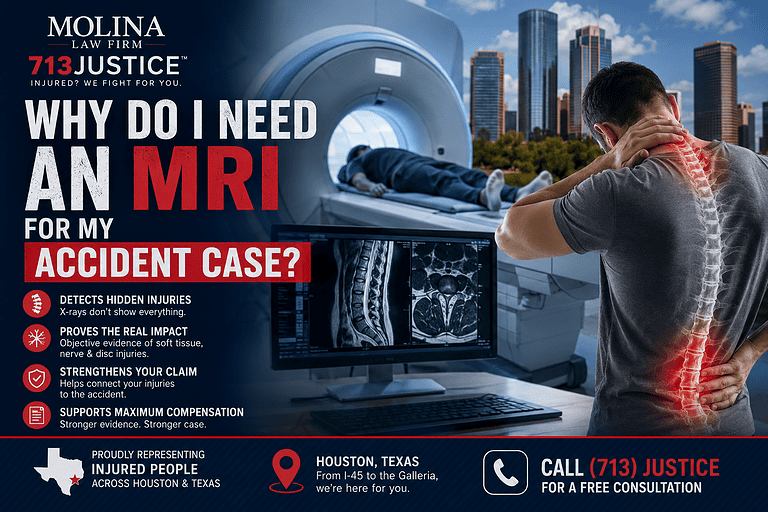
If you were hurt in a Houston car accident, an MRI after an accident case may help show injuries that X-rays or CT scans do not fully explain. A MRI after an accident is often used to evaluate soft tissue injuries, herniated discs, nerve compression, disc bulges, ligament injuries, and spinal trauma. A spine MRI after an accident can assess trauma injuries to the bone, disc, ligament, spinal cord, and nerves.
For a personal injury claim, an MRI can help connect your symptoms to objective medical findings. This matters because insurance companies often argue that pain is “subjective” unless there is imaging, medical documentation, and consistent treatment.
In a Houston accident case, especially after crashes on I-45, I-10, Highway 59, Beltway 8, 610, or near the Texas Medical Center, an MRI may become important when you have ongoing neck pain, back pain, radiating pain, numbness, tingling, weakness, headaches, or symptoms that do not improve with conservative care.
Key Takeaways
An MRI for accident case purposes is not ordered just because a lawsuit exists. It is usually ordered when your doctor believes advanced imaging may help explain your symptoms.
An MRI may show injuries to discs, nerves, ligaments, the spinal cord, and other soft tissues that may not appear clearly on an X-ray.
Insurance companies often look for objective evidence. An MRI can help document injuries such as a disc herniation, disc protrusion, annular tear, nerve root compression, or spinal inflammation.
Not every accident victim needs an MRI. The decision should be made by a medical provider based on symptoms, exam findings, medical history, and response to treatment.
If your symptoms are worsening, radiating into your arms or legs, or continuing for weeks after the crash, an MRI may become an important part of both your medical care and your personal injury claim.
Why an MRI After An Accident Case Evidence Matters
After a crash, many people are told their X-rays are “normal.” That can be confusing because the pain is real. The problem is that X-rays mainly show bones. They are not designed to fully evaluate discs, nerves, ligaments, spinal cord irritation, or many soft tissue injuries.
An MRI for accident case evidence can help fill that gap. MRI imaging may show whether trauma from the collision caused or aggravated a spinal condition. In a personal injury claim, this may help prove that your injuries are more than soreness.
MRI Imaging Can Show Injuries That Are Not Obvious on X-Ray
A person can leave the emergency room with normal X-rays and still have a serious neck or back injury. MRIs are commonly used to evaluate trauma-related injuries to the spine, including the discs, ligaments, spinal cord, and nerves.
This is important in Houston car accident cases because many crashes involve sudden acceleration, deceleration, twisting, or compression forces. A rear-end crash on I-45 or a T-bone collision near Loop 610 may not fracture a bone, but it can still injure the structures around the spine.
MRI Results Can Help Explain Pain, Numbness, and Tingling
When pain travels from the neck into the shoulder, arm, or hand, doctors may suspect nerve involvement. When pain travels from the low back into the buttock, leg, or foot, doctors may suspect sciatica or lumbar nerve irritation.
An MRI can help identify whether a disc is touching, narrowing, irritating, or compressing a nerve. RadiologyInfo notes that spine MRI is used to assess compression or inflammation of the spinal cord and nerves.
When Do You Need a Car Accident MRI After Neck or Back Pain?
You may need a car accident MRI when your symptoms do not match a simple strain or sprain. Many accident victims try physical therapy, chiropractic care, medication, rest, or injections before an MRI is ordered. The timing depends on your symptoms and your doctor’s judgment.
The American College of Radiology recognizes different imaging considerations depending on the clinical situation. For example, its low back pain criteria include a category for persistent or progressive symptoms after conservative medical management when the patient may be a surgery or intervention candidate.
Persistent Pain After the Accident May Justify Advanced Imaging
If your neck or back pain continues for weeks after a crash, your provider may order an MRI to better understand the injury. Persistent pain can suggest that the problem is not just temporary soreness.
This is especially true if you have trouble working, sleeping, driving, lifting, walking, or caring for your family. In a personal injury case, those daily-life limitations should be documented along with the MRI findings.
Radiating Pain, Numbness, or Weakness Are Important Warning Signs
Radiating pain is different from ordinary soreness. Pain that shoots down the arm or leg may suggest that a nerve is being affected. Numbness, tingling, weakness, or loss of grip strength can also be important symptoms.
If these symptoms appear after a Houston car wreck, an MRI may help your doctor determine whether the crash caused a disc injury, nerve compression, or another spinal condition.
How an MRI Helps Prove a Personal Injury Claim in Texas
Insurance companies often try to minimize injury claims by saying the victim only has “soft tissue pain.” An MRI can change the discussion because it may provide objective medical evidence.
Objective evidence means something that can be seen, measured, documented, or interpreted by medical professionals. In a Texas personal injury case, that can matter when negotiating with an insurance adjuster or presenting the case to a jury.
MRI Findings Can Support Causation
Causation means proving that the accident caused or aggravated the injury. Insurance companies often argue that MRI findings are “old,” “degenerative,” or unrelated to the crash.
That is why timing, symptoms, medical history, and consistent treatment matter. If you had no serious neck or back symptoms before the crash, then developed pain afterward, and the MRI shows a disc injury consistent with your symptoms, that can strengthen the case.
MRI Findings Can Support Damages
Damages include medical bills, pain and suffering, lost wages, future treatment, impairment, and loss of enjoyment of life. An MRI may help show why the injury required treatment beyond a quick emergency room visit.
For example, a herniated disc with nerve symptoms may lead to pain management, injections, orthopedic evaluation, neurosurgical consultation, or future care recommendations. That can increase the seriousness of the claim.
What Types of Injuries Can an MRI Show After a Car Accident?
An MRI does not prove everything, but it can show many injuries that matter in accident cases. The most common car accident MRI findings usually involve the cervical spine, lumbar spine, shoulders, knees, or brain depending on the symptoms.
For neck and back injury claims, the MRI report often becomes one of the most important documents in the case.
Herniated Discs, Disc Protrusions, and Disc Bulges
A herniated disc occurs when disc material moves outside its normal space. A protrusion or bulge may narrow the area around the nerves or spinal canal.
These findings are important because they can explain pain that does not go away. They may also explain symptoms that travel into the arms or legs.
Ligament, Spinal Cord, and Nerve-Related Injuries
MRI imaging may also help evaluate ligament injuries, spinal cord changes, inflammation, and nerve compression. RadiologyInfo lists trauma injury to the bone, disc, ligament, or spinal cord among common uses for spine MRI.
This matters because ligament and nerve injuries may not be visible on basic X-rays. A person may look “fine” externally but still have internal injuries that affect mobility, strength, and daily function.
Why Insurance Companies Care About MRI Results in Accident Claims
Insurance companies care about MRI results because imaging can affect case value. A claim with only emergency room records and general pain complaints may be treated differently than a claim with an MRI showing a disc herniation and nerve compression.
That does not mean every MRI automatically increases the value of a case. The MRI must be connected to the crash, the symptoms, the treatment plan, and the medical opinions.
Adjusters Look for Objective Proof
Insurance adjusters are trained to question injury claims. They may argue that the crash was minor, the damage to the vehicle was not severe, or the treatment was unnecessary.
An MRI can help push back against those arguments. When the imaging matches the symptoms and the treatment, it can help show that the injury is real and medically significant.
Adjusters Also Look for Gaps and Inconsistencies
An MRI alone is not enough. If there are long treatment gaps, inconsistent complaints, or prior similar injuries, the insurance company will use those issues against the claim.
That is why it is important to follow medical advice, attend appointments, explain all symptoms clearly, and tell your doctors how the injury affects your work and daily life.
Do You Always Need an MRI After a Houston Accident?
No. Not every accident victim needs an MRI. Some injuries improve with conservative treatment, and some symptoms do not require advanced imaging.
A doctor should decide whether an MRI is medically appropriate. The decision depends on your symptoms, physical exam, medical history, prior injuries, and whether your condition is improving or getting worse.
Minor Soreness May Not Require an MRI
If you have mild soreness that improves quickly, your doctor may not recommend an MRI. Imaging is not always necessary in every accident case.
In fact, unnecessary imaging can create confusion if the MRI shows unrelated age-related findings. The goal is not to order tests just for litigation. The goal is to understand the injury and guide treatment.
Serious or Ongoing Symptoms Should Be Evaluated
If you have severe pain, worsening symptoms, radiating pain, numbness, tingling, weakness, balance problems, or difficulty walking, you should seek medical care promptly.
In those situations, an MRI may help your doctor identify a more serious injury. It may also help protect your personal injury claim by documenting the medical basis for your symptoms.
Houston Accident Cases: Why Local Medical Documentation Matters
Houston accident cases often involve serious crashes on congested roads. Drivers in Harris County deal with heavy traffic on I-10, I-45, Highway 59, Beltway 8, Loop 610, SH-288, and roads near the Port of Houston.
When an accident happens in Houston, medical documentation becomes extremely important. The insurance company will review when you first sought treatment, what symptoms you reported, what imaging was ordered, and whether the medical findings are consistent with the crash.
Houston Roads Can Create High-Impact Collision Forces
A rear-end crash on the Katy Freeway or a side-impact crash near the Galleria may involve more force than people realize. Even when vehicles are repaired quickly, the human body may continue to suffer.
Neck and back injuries can worsen over time. Pain may begin as stiffness and later develop into radiating symptoms, headaches, numbness, or weakness.
Medical Records Help Tell the Story of the Injury
Your medical records should tell a clear story: the crash happened, symptoms began, treatment followed, symptoms persisted, and an MRI was ordered for a medical reason.
That story is powerful in a personal injury case. It helps connect the collision to the injury and the injury to the damages.
FAQs About Getting an MRI for an Accident Case
Do I need an MRI if my X-ray was normal?
Maybe. A normal X-ray does not rule out every injury. X-rays mainly evaluate bones. An MRI can evaluate discs, ligaments, nerves, spinal cord issues, and soft tissue injuries. Your doctor should decide whether an MRI is appropriate based on your symptoms.
Will an MRI prove my car accident injury?
An MRI can help prove an injury, but it does not prove the entire case by itself. The MRI must be connected to the crash, your symptoms, your medical history, your physical exam, and your treatment.
What if the insurance company says my MRI shows degeneration?
Insurance companies often argue that MRI findings are degenerative or pre-existing. That does not automatically defeat your claim. If the accident aggravated a prior condition or caused new symptoms, the MRI may still be important evidence.
How soon after an accident should I get an MRI?
The timing depends on your symptoms and your doctor’s medical judgment. Some MRIs are ordered quickly when symptoms are severe. Others are ordered after conservative treatment does not resolve the pain.
Can an MRI increase the value of my accident case?
It can, especially if the MRI shows a serious injury that matches your symptoms and treatment. A herniated disc, nerve compression, or ligament injury may support a higher claim value than general soreness alone.
What symptoms may justify an MRI after a crash?
Symptoms that may justify an MRI include severe neck pain, low back pain, pain radiating into the arms or legs, numbness, tingling, weakness, headaches, balance problems, or symptoms that continue despite treatment.
What if I cannot afford an MRI?
Some medical providers may offer treatment through health insurance, letters of protection, or other arrangements depending on the case. A personal injury lawyer can help you understand your options, but medical decisions should always be made by a healthcare provider.
Is an MRI painful?
No. An MRI is non-invasive, but some patients feel uncomfortable because they must remain still inside the machine. Tell your doctor if you are claustrophobic or have metal implants.
Call 713Justice After a Houston Accident
If you were injured in a Houston car accident and your doctor recommended an MRI, Molina Law Firm can help you understand how the MRI may affect your personal injury case.
The insurance company is already building its defense. You should be building your proof.
Call (713) Justice today for a free consultation with Molina Law Firm and the 713Justice team.
Author Information
Rick Molina
Molina Law Firm | 713Justice
Houston, Texas Personal Injury Lawyer
Molina Law Firm represents injured people in Houston and throughout Texas in car accident, truck accident, personal injury, and wrongful death claims. The firm’s blog uses Houston-focused personal injury content and local references, including recent posts on Houston roadway accidents, truck accidents, insurance claims, and personal injury issues.
Related Links
- WRONGFUL DEATH:
- What Happens When An Unlicensed Driver Causes a Fatal Accident?
- Hit and Run Accidents
- Houston Wrongful Death Accident Claims
- Houston Wrongful Death Head-On Collisions
- Houston Wrongful Death Accident Attorney
- CAR ACCIDENTS:
- Experienced Houston Car Wreck Attorney
- Car Travel With Dogs
- Accidents, Emergency Rooms, and Urgent Care
- Houston Wrong Way Driving Accident Lawyer
- Texas Negligent Entrustment Claims
- Houston Auto Accident Attorney
- Accident Lawyers
- Rideshare Accidents
- Houston Chain Reaction Car Accident
- Houston Hit and Run Accident Lawyer
- Houston Teen Driving Accidents
- SAGEMONT ACCIDENT & INJURY:
- Sagemont Accidents
