

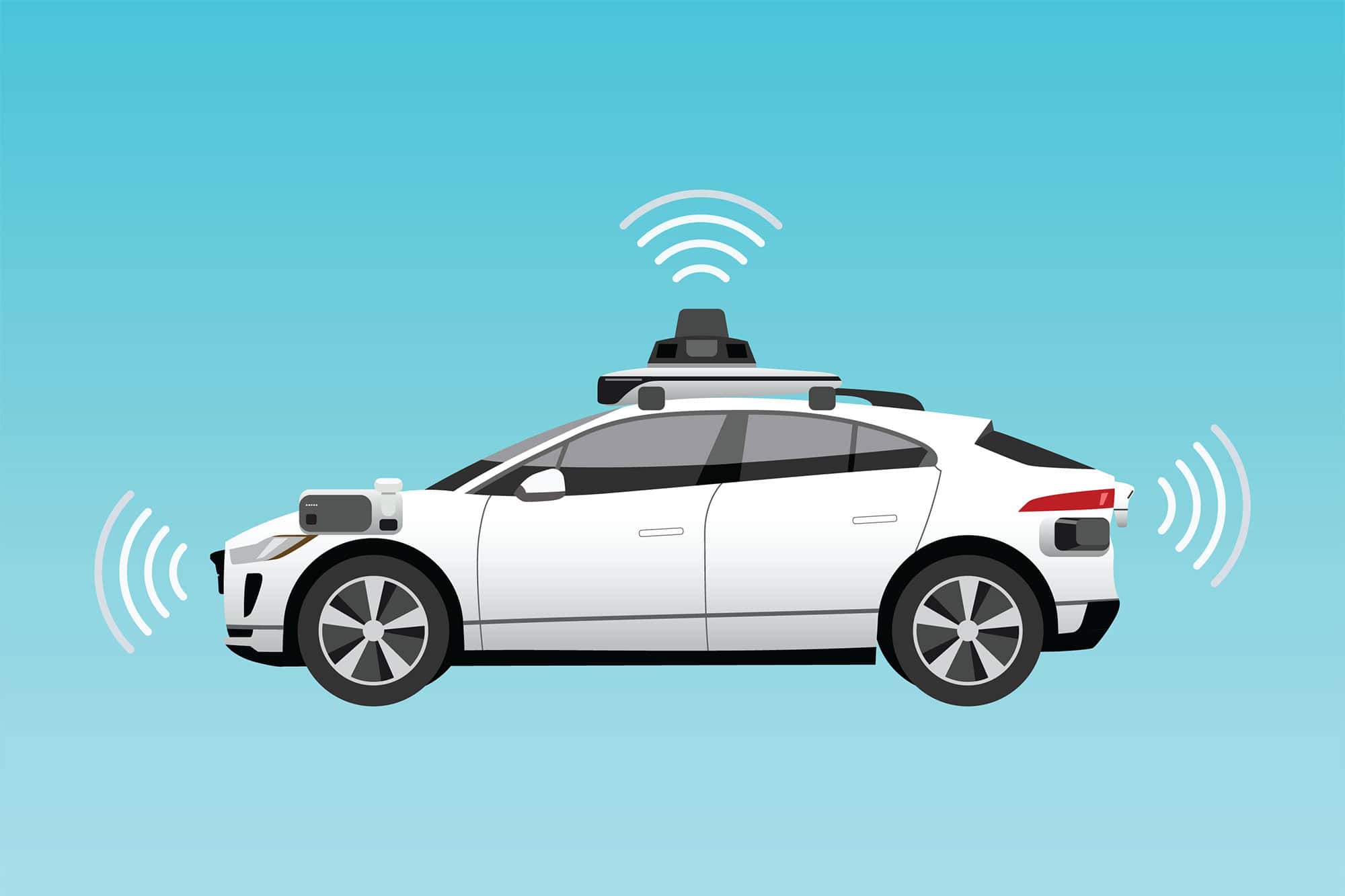
Self-driving or autonomous vehicles are already here in Houston. You likely have done a double-take when you’ve seen a car with no driver. These cars are here, and the reality is, we need to be aware of who is responsible when there is an autonomous vehicle accident.
If you spent any time on the Beltway or navigating the narrow, bustling streets of South Houston lately, you’ve likely seen them: cars bristling with spinning lidar sensors and cameras, navigating our Texas traffic with a ghost at the wheel. In 2026, autonomous vehicles (AVs) have transitioned from a Silicon Valley experiment to a staple of the Houston economy. They deliver our groceries, they shuttle us to Minute Maid Park, and they promise a future where “human error” is a relic of the past.
But as any Houstonian knows, our roads are unpredictable. A sudden Gulf Coast downpour can turn a dry highway into a mirror of standing water in seconds. Construction on I-45 seems to shift lane lines overnight. In these moments, the “perfection” of an algorithm is put to the test. And when that algorithm fails—when a robotaxi miscalculates a merging semi-truck or a self-driving delivery van fails to see a cyclist on Westheimer—we are left with a question that the law is still racing to answer: Who do you sue when there is no driver?
At the Molina Law Firm, we’ve spent decades holding negligent drivers accountable. But in this new era, the “driver” is a complex web of code, sensors, and remote servers. If you’ve been involved in a collision with an autonomous vehicle, you aren’t just fighting an insurance company; you are taking on some of the most powerful technology corporations on the planet. Understanding the landscape of 2026 liability isn’t just a legal necessity—it’s the only way to ensure you aren’t left holding the bill for a computer’s mistake.
Autonomous Vehicle Accident--713Justice
There is a common misconception that because the technology is new, the law is a “Wild West” where no rules apply. This couldn’t be further from the truth. In fact, Texas has been a pioneer in creating a framework for autonomous transit. Under current 2026 Texas statutes, specifically those refined following the landmark legislative sessions of 2025, the state has made one thing very clear: an autonomous vehicle must have an “owner” who is legally responsible for its actions on the road.
However, “responsibility” is a broad term. In a traditional car accident, the process is linear. We look at the person behind the wheel. Were they texting? Were they speeding? Did they run a red light? Once we establish that human act of negligence, the path to recovery is relatively straightforward. With an AV, that linear path becomes a spiderweb.
When a self-driving car causes a wreck in Houston today, we have to look behind the curtain. We aren’t just looking for a “bad driver”; we are looking for a “bad system.” This shifts the entire weight of the case from the realm of simple negligence into the high-stakes world of product liability and algorithmic failure. The “Self-Driving Dilemma” is essentially a shift from suing a person to suing a process.
The Architecture of an Algorithm: Where the Failure Begins
To understand who is liable, you first have to understand how these vehicles “see” Houston. An autonomous vehicle relies on a “perception stack”—a combination of Lidar (light detection and ranging), Radar, and high-resolution cameras. This hardware feeds data into an Artificial Intelligence (AI) that makes split-second decisions.
Liability often begins at the hardware level. If a camera lens was obscured by Houston’s notorious humidity and the heating element failed to clear it, leading to a blind spot that caused a crash, we are looking at a hardware defect. If a Lidar sensor produced “noise” during a heavy rainstorm and the software misinterpreted a pedestrian as a ghost image, we are looking at a failure of the sensor manufacturer.
But the most complex cases—the ones that are defining 2026 legal precedents—involve “Algorithmic Negligence.” This occurs when the hardware works perfectly, but the “brain” of the car makes a choice that a reasonable human never would. For instance, some AI models are programmed to prioritize the safety of the vehicle’s occupants over external objects. If the car swerves into a sidewalk of pedestrians to avoid a minor fender-bender with an oncoming truck, who is responsible for that programming choice? The engineers? The board of directors who approved the safety “ethics” of the code? These are the questions we are litigating today.
Texas Senate Bill 2807 and the 2026 Mandate
As of early 2026, Texas has implemented strict requirements for any entity operating Level 4 or Level 5 autonomous vehicles on public lands. One of the most significant changes is the requirement for a “Dynamic Driving Task” (DDT) fallback. This means that if the system fails, there must be a programmed protocol to bring the vehicle to a “minimal risk condition”—essentially a safe stop.
If an AV stops in the middle of a high-speed lane on the Gulf Freeway because its software “glitched,” and it causes a chain-reaction pileup, the manufacturer may be liable for a failure of that fallback system. Texas law now treats the “Automated Driving System” (ADS) as the legal driver of the vehicle. This is a massive win for victims because it prevents companies from blaming a “passenger” for not grabbing a steering wheel that might not even exist in the vehicle.
However, this doesn’t mean the companies won’t try to shift the blame. We are seeing a rise in “secondary liability” claims where the AV company blames the city’s infrastructure—claiming a faded lane line or a malfunctioning smart-traffic signal was the true cause. This is why having a local Houston attorney is vital; we know our streets, we know our city’s maintenance records, and we won’t let a billion-dollar tech company use a pothole as an excuse for their software’s failure to brake.
The Data War: Your Most Important Evidence is Invisible
In a 2026 injury claim, the “smoking gun” isn’t a skid mark on the asphalt; it’s a file of encrypted data sitting on a server in Austin or Silicon Valley. Autonomous vehicles are essentially rolling data centers. They record every heartbeat of their system: the exact millisecond they detected an object, the “confidence level” the AI assigned to that object, and the precise mechanical response triggered.
This data is the most objective witness we have ever had in personal injury law, but there is a catch. The companies that own the cars also own the data. They have a vested interest in “curating” that data before it ever reaches a courtroom.
At the Molina Law Firm, our first step in any AV accident case is an immediate “Letter of Preservation.” We legally compel the company to lock down all data logs from the moment of the crash. We look for:
- Telematics: The speed, braking force, and steering angle.
- Sensor Logs: What the car “thought” it saw vs. what was actually there.
- Version History: Was the car running on an outdated version of its software? Had the company pushed a “beta” update to the fleet that hadn’t been fully vetted for Houston’s specific climate or traffic patterns?
Without this data, you are fighting with one hand tied behind your back. These companies will show up with polished animations and “simulations” of the crash that favor their narrative. Our job is to dig into the raw code and find the truth.
The Gig Economy and the "Shadow" Fleet
Another layer of the 2026 dilemma involves the “mixed” fleet. Not every autonomous vehicle is owned by a massive corporation like Waymo or Cruise. Many are personal vehicles equipped with high-level “Full Self-Driving” (FSD) capabilities, often being used for gig-work delivery or rideshare.
If you are hit by a private citizen using their car’s autonomous features to deliver for a food app, the insurance complications are staggering. The driver’s personal insurance may deny the claim because the car was being used for business. The gig-app company may deny the claim by saying the driver violated their terms by “disengaging” from the task of driving. And the car manufacturer may deny the claim by saying the driver didn’t follow the “user manual” for the autonomous system.
This “circular finger-pointing” is designed to exhaust the victim. They want you to settle for pennies just to make the headache go away. We don’t let that happen. We track the insurance “periods” of the gig economy and marry them to the product liability of the vehicle manufacturer. If the tech was engaged, the tech is responsible.
The Role of the "Human Monitor"
Even in 2026, many vehicles on Houston roads are “Level 3″—meaning they can drive themselves in most conditions, but a human is expected to take over if the system requests it. This creates a very dangerous legal gray area known as “Automation Complacency.”
Research shows that it takes a human several seconds to regain “situational awareness” after being disengaged from driving. If the car alerts the driver to “Take Control” only two seconds before an impact, is the human really at fault for failing to react? The car companies say yes. We say no.
We argue that if a system is designed to allow a driver to disengage, it must be robust enough to handle the transition of power safely. If the “hand-off” protocol is flawed, that is a design defect. We look at the internal cabin cameras—which many of these cars have—to prove that the driver was following the car’s instructions and that the system’s failure was the “proximate cause” of the injuries.
Why the "Standard" Insurance Policy is Obsolete
The insurance industry is currently undergoing a massive upheaval. In the past, liability was tied to the “Individual.” In the future—and increasingly in 2026—liability is tied to the “Product.”
For a Houston resident, this means that your own Uninsured/Underinsured Motorist (UM/UIM) coverage is more important than ever. If you are hit by a prototype AV or a company that declares bankruptcy after a series of fleet-wide failures (as we saw with several start-ups in the mid-2020s), you need a safety net.
Furthermore, the “limits” on these policies are different. When we sue a tech giant for a software failure that caused a catastrophic injury, we aren’t looking at a $30,000 policy limit. We are looking at commercial liability policies worth tens of millions. This changes the entire strategy of the case. It’s no longer about a quick settlement; it’s about a comprehensive deep-dive into the corporate structure and the safety testing protocols of the company.
The "Ethics" of the Machine: A New Frontier in Court
One of the most fascinating—and chilling—aspects of these cases is what we call the “Trolley Problem” in the courtroom. If a self-driving car’s AI is forced to choose between hitting a child who ran into the street or swerving into a concrete barrier and killing the car’s lone occupant, how is it programmed to choose?
In 2026, these “priority settings” are becoming discoverable in court. If we can prove that a company programmed its cars to value the vehicle’s survival over the lives of pedestrians to protect its brand image or minimize repair costs, we aren’t just looking at negligence—we are looking at a potential claim for punitive damages. This is about more than just one accident; it’s about holding the architects of our future to a standard of human decency.
Looking Ahead: Protecting Houston Families
The transition to autonomous transit is inevitable, and in many ways, it will make our city safer. But the road to that future is paved with the “growing pains” of a technology that is still learning the nuances of a Houston rush hour.
You should not have to be a computer scientist to get fair compensation for a car wreck. You should not have to spend years in a legal “black hole” because a company claims their code is a “trade secret” that can’t be examined in court.
At the Molina Law Firm, we believe that the same principles of justice that applied in the days of horse-and-buggy still apply in the days of AI and Lidar. If a company puts a product on our streets, that product must be safe. If it isn’t, that company must pay for the harm it causes.
Final Thoughts for the 2026 Commuter
A car accident on a Houston freeway happens in a split second, but the recovery can take a lifetime. Don’t let insurance adjusters undervalue your claim or rush you into a settlement that doesn’t cover your future needs. At Molina Law Firm, we know the tactics they use, and we know how to fight back. We’re ready to help you get back on the road to recovery.”
Contact Molina Law Firm today for a free case evaluation. Let’s get you the settlement or jury trial you deserve.
The “Self-Driving Dilemma” is a challenge we face together as a city. As your neighbors and your advocates, the Molina Law Firm is here to make sure that as the cars get smarter, the justice system stays even sharper. We are ready to decode the data, challenge the algorithms, and ensure that no matter who—or what—is behind the wheel, your rights are protected.
#713Justice
