

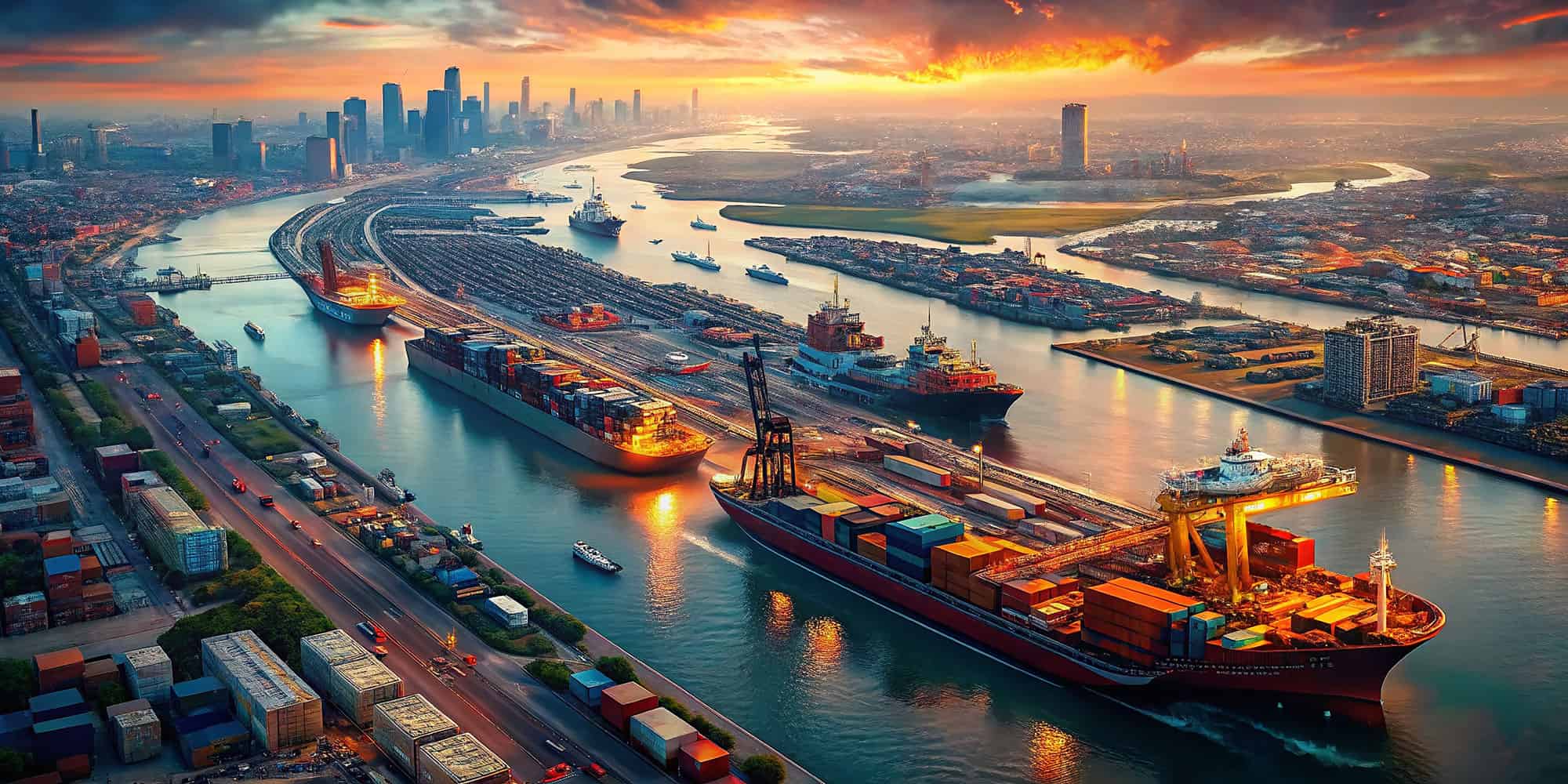
If you live in Houston — especially on the east side — you already know what it feels like to share the road with 18-wheelers. You know the rumble of a fully loaded semi next to you on the East Freeway. You know the anxiety of merging onto SH-225 with a tanker truck riding your bumper. And if you drive near the Port of Houston or the Houston Ship Channel on a regular basis, you know that the sheer volume of commercial truck traffic in that area is unlike anything most drivers in America ever deal with.
What you may not fully appreciate, though, is just how enormous the numbers really are — and what those numbers mean for your safety every single time you get behind the wheel.
At Molina Law Firm, we’ve helped many Houston families who were seriously hurt in 18-wheeler accidents near the Port of Houston and the Ship Channel corridor. We’ve seen firsthand the devastation that a collision with a fully loaded commercial truck can cause. And we believe that an educated community is a safer one. So let’s talk about what’s happening on those roads, why it matters, and what you should do if you or someone you love has been hurt in a truck accident near the Port of Houston.
The Port of Houston-- Huge Port with Lots of Truck Traffic
To understand why truck traffic is so overwhelming in this part of Houston, you first need to understand just how dominant the Port of Houston is as a commercial force.
The Houston Ship Channel ranks first in the United States for foreign waterborne tonnage, handling 220.1 million short tons in 2024. It’s also the second-ranked U.S. port in terms of total foreign cargo value, at $222.5 billion in 2023. And as if those numbers weren’t staggering enough on their own, Port Houston is the largest Gulf Coast container port, handling 74% of all U.S. Gulf Coast container traffic.
Think about that for a moment. Three out of every four containers moving through the entire Gulf Coast passes through Houston. That’s not just a local story — that’s a national economic engine running right through our neighborhoods.
And it’s getting busier, not slower. In 2024, Port Houston handled a record 4.14 million TEUs — twenty-foot equivalent units, the standard measure for container shipping — an 8% increase over the previous year. Cargo volume at public terminals alone hit a record 53.1 million tons, a 6% increase over 2023.
The records just keep falling. In January 2026 alone, Port Houston had its busiest January on record for containers, handling 370,034 TEUs — a 4% increase from the same month the previous year. Vessel volumes for the entire port were up 2% compared to 2025, which was itself a strong year.
One statistic from January 2026 stands out above all others when it comes to understanding what this means for drivers like you and me: Port Houston recorded a single-day record of 16,438 truck transactions at its container terminals in a single day. That’s more than 16,000 truck moves at just the container terminals — in one day. Add in the tankers, the chemical carriers, the flatbeds hauling industrial equipment, the oversized loads serving the refineries, and the number of commercial truck trips in and around the Ship Channel on any given day becomes almost incomprehensible.
The Connection Between Port Activity and Truck Traffic on Your Roads
Here’s something that a lot of people don’t think about: every single container that arrives by ship has to leave the port by truck. There is no other option. It doesn’t fly out. It doesn’t teleport. It gets loaded onto an 18-wheeler and driven somewhere — often at peak commuting hours, through the same streets and freeways you use to get to work, take your kids to school, or drive home at the end of the day.
The 4.14 million TEUs handled in 2024 translate directly into millions of truck trips on Houston’s roads. Each container requires at least one truck trip, and many require multiple trips as goods move from port to warehouse, warehouse to distribution center, and distribution center to final destination.
And it doesn’t stay confined to the industrial areas near the water’s edge. TxDOT’s Houston District Truck Mobility Study found that the most common type of regional truck trip is short-haul, first-mile, and last-mile travel related to local freight nodes such as warehouses, distribution centers, and intermodal hubs. This means port-related truck traffic isn’t limited to major highways near the Ship Channel — it extends throughout Houston’s entire street network, increasing the likelihood of accidents in residential and commercial areas far from the port itself.
In plain language: the danger doesn’t stay near the water. It follows these trucks wherever they go.
The Roads Most Affected: A Ground-Level Look
If you want to understand which roads carry the heaviest concentration of port-related truck traffic — and therefore pose the highest risk for 18-wheeler accidents near the Port of Houston — there are a few corridors that stand out above the rest.
State Highway 225 (The La Porte Freeway / Pasadena Freeway)
SH-225 is arguably the most intense trucking corridor in the region. Highway 225 runs through Pasadena, Deer Park, and into the heart of the Ship Channel’s refinery and chemical plant corridor. Every day, thousands of 18-wheelers travel this stretch transporting fuel, chemicals, containers, and industrial materials to and from major facilities and port terminals.
The 15.78-mile state highway terminates just south of the Fred Hartman Bridge, which carries SH-146 across the Houston Ship Channel. A heavily traveled truck route, SH-225 runs past a number of refineries, chemical plants, and tank farms.
What makes SH-225 especially treacherous isn’t just the volume of trucks — it’s the nature of what those trucks are carrying. Tanker trucks hauling volatile chemicals, oversized loads serving the petrochemical plants, flatbeds loaded with heavy industrial equipment — these aren’t just big vehicles, they’re rolling hazards. Serious collisions frequently occur near plant entrances, merging lanes, and congested interchanges where commercial trucks and passenger vehicles are forced to navigate tight spaces. Because tractor-trailers can weigh up to 80,000 pounds, crashes often lead to catastrophic injuries including spinal trauma, head injuries, internal bleeding, and permanent disability.
News reports of incidents on SH-225 are a regular occurrence. Overturned 18-wheelers causing major delays. Fuel spills shutting down multiple lanes near Beltway 8. Heavy trucks stalling in traffic and creating sudden hazards for drivers behind them. If you drive this road regularly, these events are not surprises — they’re just part of the reality of sharing a highway with one of the most concentrated industrial truck traffic corridors in the country.
Interstate 10 (The East Freeway)
I-10 is the main artery connecting the Port of Houston to the broader highway network, and it shows. The stretch of I-10 east of downtown Houston — running toward Baytown and the outer reaches of the Ship Channel — sees heavy commercial truck traffic around the clock. In just the first half of 2025 alone, I-10 in Houston saw numerous catastrophic incidents, many involving commercial trucks, hazardous materials, and multiple fatalities.
The section between the I-610 Loop and Highway 6 is considered one of the most crash-prone stretches, where dense traffic, ongoing construction, and major merges create constant hazards. Rear-end crashes, jackknife accidents, and multi-vehicle pileups are all too common here, especially when an 18-wheeler is involved and other vehicles don’t have enough time — or distance — to react.
Truck accidents on I-10 near the port area don’t just injure people. They shut down Houston’s most critical east-west corridor for hours at a time. It appears that a commercial vehicle accident frustrates commuters at least once a week in the greater Houston area. That’s not a weather event or a random fluke — it’s a predictable consequence of putting tens of thousands of heavy commercial vehicles on roads that were never designed to handle this kind of volume.
Loop 610 (Particularly the East and South Loops)
Loop 610 serves as the connector between the major inbound and outbound freeways and the industrial zones of the East Side. Heavy industrial activity in southeastern Houston results in concentrated 18-wheeler flow during shift changes, causing bottlenecks on SH-225 and the I-610 South Loop. These traffic surges force trucks into unsafe maneuvers to maintain schedules.
The East Loop along 610 is a particularly tight and unforgiving stretch of road for large commercial vehicles. The ramps are narrow, the interchanges are complex, and the speed differentials between trucks and passenger cars can be dramatic. Accidents involving 18-wheelers on the 610 East Loop are frequent enough that Houstonians who drive it regularly often describe it as the most stressful part of their commute.
Beltway 8 and the Ship Channel Bridge
Beltway 8 was designed partly to serve as a bypass route for commercial freight around the inner city, and the Sam Houston Ship Channel Bridge is a critical link in that chain. Both SH-225 and Beltway 8 are major freight corridors connecting to the Port of Houston and major industries along the Ship Channel. The intersection of these two corridors near Pasadena has long been identified as a significant chokepoint, with regional stakeholders including Harris County, the Port of Houston, and TxDOT all recognizing it as a problem that needs infrastructure investment.
The Human Factor: Why So Many Port Truck Accidents Happen
The sheer number of trucks on these roads is part of the problem. But it doesn’t fully explain why accidents happen. To understand that, you have to look at the pressures that commercial truck drivers — especially port drayage drivers — operate under every single day.
Port operations create predictable surge periods in truck traffic that unfortunately coincide with commuter rush hours. Morning hours see trucks rushing to pick up containers that arrived overnight or were unloaded during the night shift. Afternoon and evening hours see trucks delivering goods to warehouses, distribution centers, and retail locations. These peak periods multiply the potential for accidents as stressed, time-pressured truck drivers navigate alongside thousands of passenger vehicles.
Time pressure is one of the most dangerous forces in trucking. When a ship arrives with containers, the port wants them moved quickly to make room for the next ship. Warehouses want goods delivered on schedule. Retailers need products on shelves. All of this pressure flows down to truck drivers who may feel compelled to drive faster, work longer hours, or take risks they wouldn’t otherwise take. Companies may offer incentives for fast turnaround or penalize drivers for delays — and when that pressure builds up in the cab of an 80,000-pound vehicle traveling at highway speed, the consequences of a single bad decision can be catastrophic.
Driver fatigue is another major factor. Federal regulations allow truck drivers to drive up to 10 or even 11 hours per day, and many accidents occur simply because the driver was drowsy at the time of the accident. A driver who has been working a long shift hauling containers from Barbours Cut to a distribution center in the suburbs is not at their best when they’re navigating the complex interchange at I-10 and 610 in stop-and-go traffic.
Beyond fatigue, the same patterns repeat in accident investigations across Houston. Speeding and reckless driving. Distracted driving. Improper lane changes. Overloaded or improperly secured cargo. Brake failures from inadequate maintenance. Inadequate driver training. These aren’t freak occurrences — they’re predictable failures that trucking companies have both the responsibility and the ability to prevent.
The word “preventable” matters here. Most 18-wheeler accidents near the Port of Houston are not accidents in the sense of being unavoidable. They are the result of choices made by drivers, dispatchers, fleet managers, and company executives. And when those choices result in someone getting hurt, there is accountability to be had.
What Makes 18-Wheeler Accidents Different — and More Dangerous
If you’ve never been in a serious truck accident, it can be tempting to think of it as just a bigger version of a car crash. It isn’t.
A fully loaded 18-wheeler hauling a container from Barbours Cut can weigh as much as 80,000 pounds. The average passenger car weighs about 4,000 pounds. When those two vehicles collide at highway speed, the physics are devastating. Stopping distances are dramatically longer. The force of impact is multiplied. The risk of catastrophic, life-altering injuries — traumatic brain injuries, spinal cord damage, internal bleeding, amputations, wrongful death — is exponentially higher than in a typical car accident.
The legal landscape is also fundamentally different. A truck accident isn’t just a case against one driver. It may involve the trucking company, the cargo owner, the port authority, the company that loaded the container, a third-party maintenance contractor, an insurance carrier with a team of defense lawyers, and multiple layers of federal and state regulations governing everything from hours of service to cargo securement to vehicle maintenance requirements. Evidence — including electronic logging device data, GPS records, dashcam footage, and maintenance logs — needs to be preserved quickly before it disappears or is overwritten. The clock starts ticking the moment a crash happens.
This is why having an experienced attorney on your side matters so much in an 18-wheeler accident case. These cases are complex. The opposing parties are well-resourced. And the stakes — your health, your financial security, your family’s future — are too high to navigate alone.
The Port Is Only Going to Get Busier
Here’s something worth understanding as you read this: the traffic is not going to thin out. If anything, the trends point clearly in the other direction.
The Port of Houston averages 50 deepdraft vessel movements per day, with the capacity to handle surges of over 90 ships per day. On average, about 400 tugs transit the Houston Ship Channel each day, transporting around 635 barges. The port is in the middle of a major channel deepening and widening project specifically designed to accommodate the next generation of mega-ships — which means even larger vessels, carrying even more containers, requiring even more truck trips to move their cargo.
The economic forces driving this growth aren’t going away. Houston sits at the center of American petrochemical production. The region is home to the largest petrochemical complex in the nation and second largest in the world. Demand for manufactured goods that flow through the port’s container terminals continues to grow. International trade through the Gulf of Mexico continues to expand. And every ton of that cargo — every single container, every tanker load, every flatbed of industrial equipment — connects to a truck that will eventually be driving on the same roads you use.
Understanding this isn’t meant to frighten you. It’s meant to encourage you to drive defensively, give commercial trucks the wide berth they need, and know your rights if the worst happens.
If You've Been Hurt in an 18-Wheeler Accident Near the Port of Houston, Here's What to Do
If you or a loved one has been injured in a truck accident near the Port of Houston, the Houston Ship Channel, or anywhere along the SH-225, I-10 East, or 610 East Loop corridors, there are some important steps to take right away.
First, get medical attention immediately — even if you feel okay. Injuries from truck accidents, especially soft tissue injuries and internal trauma, often don’t manifest their full severity right away. Your health is the priority, and having a documented medical record starting from the day of the accident is important for your case.
Second, preserve any evidence you can. Take photos of the scene, the vehicles involved, your injuries, and any road conditions that contributed to the crash. Get the contact information of any witnesses. Note the name of the trucking company on the side of the truck.
Third — and this is critical — contact an attorney before you speak with any insurance company. Trucking companies and their insurers move fast after an accident. They send investigators to the scene. They pull the electronic data from the truck’s black box. They start building their defense from day one. You deserve someone in your corner doing the same for you.
At Molina Law Firm, we understand the weight of what our clients are going through. An 18-wheeler accident doesn’t just hurt you physically — it disrupts your entire life. It affects your ability to work, to care for your family, to do the things that matter most to you. We fight to make sure the people and companies responsible for that disruption are held fully accountable, and that our clients receive the compensation they deserve for medical expenses, lost income, pain and suffering, and the full impact of their injuries.
You Don't Have to Face This Alone
The roads around the Port of Houston are some of the most heavily trafficked truck corridors in the United States. That’s not an opinion — it’s a fact backed by the record-breaking cargo volumes, the millions of container trips, and the daily reality of thousands of 18-wheelers moving through Houston’s East Side every single day.
If you’ve been hurt in an 18-wheeler accident near the Port of Houston, you deserve an attorney who understands this landscape, who knows how these cases work, and who will stand up for you against powerful trucking companies and their insurers.
When a commercial truck is involved, the injuries are often catastrophic and the legal battle is even tougher. These trucking companies have teams of lawyers working to protect their bottom line—you need a powerhouse in your corner to protect yours. At Molina Law Firm, we hold negligent trucking companies accountable for the harm they cause on our Texas highways.”
Put an experienced advocate on your side. Call us today to start your journey toward justice.
Call Molina Law Firm today for a free consultation. We are here to help you understand your rights and fight for the compensation you deserve.
